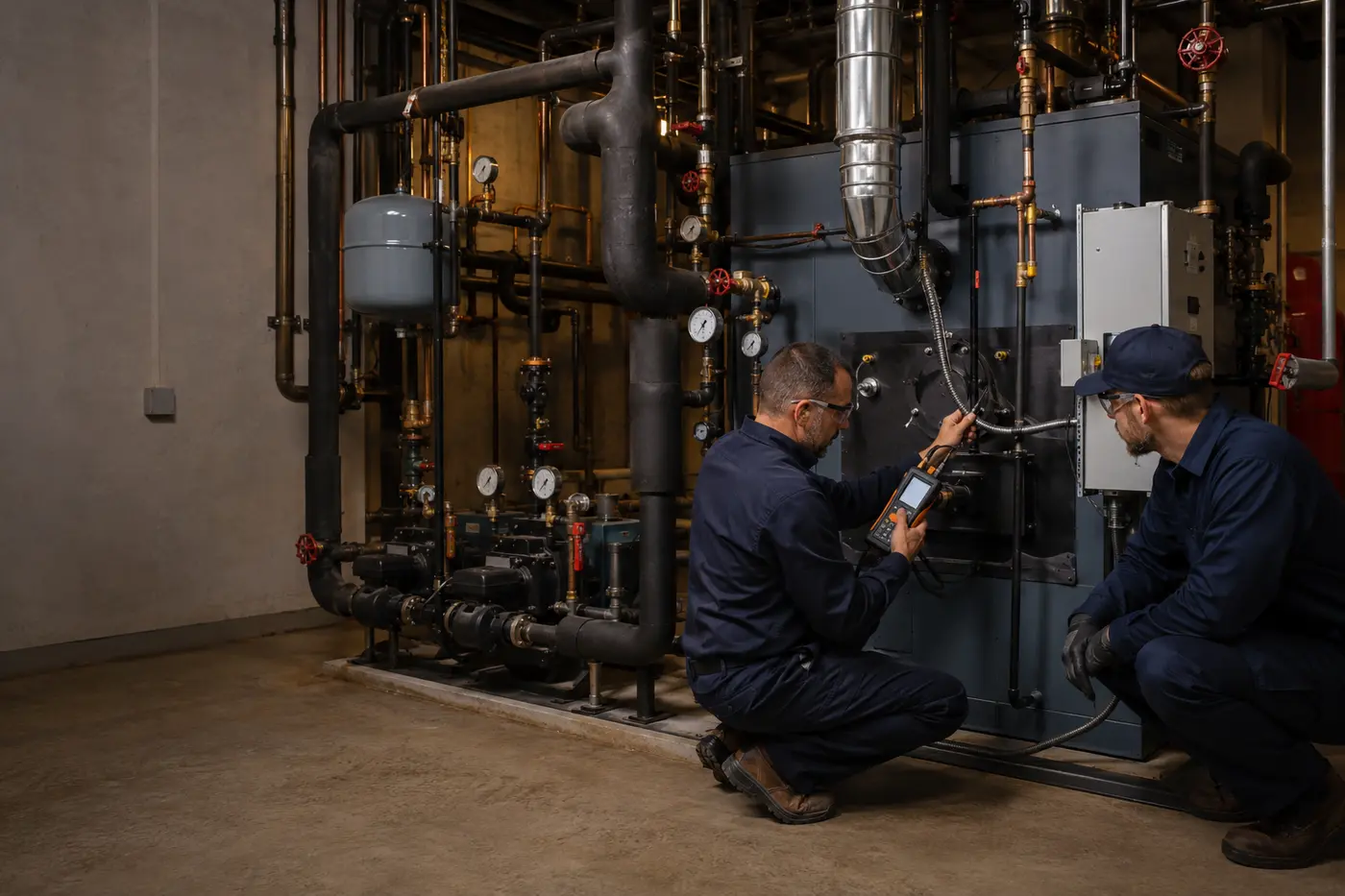
Commercial boiler maintenance before heating season is a startup and risk-control process—not a quick visual check after the building is already asking for heat. Pumps, pressure, combustion, venting, controls, water condition, and distribution all have to work together before cold weather turns a small defect into a building-wide complaint.
For property managers in Westchester County and New York City, September is the practical window to review the boiler plant, complete required service, authorize repairs, and test occupied zones. NYC's statutory heat season begins October 1, while many Westchester buildings also face their first real heating calls before maintenance backlogs are cleared.
Do not confuse three different activities: preventive maintenance, corrective repair, and a required jurisdictional or insurance inspection. One does not automatically satisfy the others.
Before the first startup, collect the current equipment list, prior service reports, inspection certificates, repair history, water-treatment records where applicable, control schedules, and unresolved tenant complaints.
Confirm which authority has jurisdiction. The New York State Boiler Safety Bureau explains that covered high-pressure boilers are generally inspected annually and covered low-pressure boilers every other year, with exceptions and separate local jurisdictions, including New York City and White Plains. The owner or qualified professional should verify the rule that applies to the specific property.
Maintenance findings should also be compared with last winter's operating history. Repeated low-pressure alarms, frequent resets, makeup-water use, noisy zones, and the same cold apartments every year are not seasonal surprises. They are unresolved diagnostic evidence.
The exact procedure depends on boiler type, fuel, manufacturer, system design, and local requirements. A qualified boiler and heating professional should build the scope around the actual plant. The following areas form a practical management checklist.
The boiler room itself often reveals the first warning signs. A bucket under a relief line, a constantly wet floor, or fresh rust below a vent connection should not be normalized because the plant still runs.
Do not tape, seal, or reassemble a suspect flue as a temporary maintenance task. Venting and combustion problems require proper diagnosis and repair.
Pressure readings are meaningful only when compared with the system design, building height, expansion control, fill arrangement, and temperature. Record cold and operating conditions instead of labeling every gauge position as “normal.”
Pressure that repeatedly falls can point to leakage, air removal, fill-valve, expansion-tank, or other hydronic problems. Pressure that rises sharply during heating may indicate an expansion-control issue. Our guide to boiler pressure loss explains why repeated refilling treats a symptom rather than the cause.
A burner can operate perfectly while a failed pump, closed valve, air-bound loop, or incorrect control command leaves tenants cold. That is why boiler startup must include distribution, not only combustion.
Expansion tanks and fill systems help maintain stable pressure as water temperature changes. A waterlogged or incorrectly charged tank, leaking relief valve, or malfunctioning fill assembly can create pressure swings and repeated service calls.
Track makeup-water use where the system permits it. Frequent addition of fresh water may hide leakage and introduce oxygen and minerals that accelerate corrosion or scaling. The response should be diagnosis—not automatically increasing fill pressure.
Water treatment is system-specific. Steam, closed-loop hydronic, condensing, and mixed-metal systems have different risks and manufacturer requirements. The maintenance agreement should state who samples, tests, treats, and documents water conditions.
Do not add chemicals based on color, odor, or a generic rule. Coordinate with the boiler manufacturer, qualified water-treatment provider, and heating contractor when water quality, inhibitor concentration, glycol condition, or repeated makeup water may be affecting the plant.
Qualified personnel should follow the boiler and burner manufacturer's procedures for startup, combustion setup, flame safeguard, fuel train, ignition, draft, operating controls, limits, low-water protection, and other safeties applicable to the equipment.
A flame that appears stable is not a combustion analysis. Likewise, a safety control that did not trip during normal operation has not necessarily been proven functional. Testing must follow the equipment, jurisdiction, and service procedure.
Short cycling may come from load mismatch, control settings, flow limitations, sensor problems, or other system conditions. Our article on boiler short cycling during cold weather explains why replacing a single control is not always the full answer.
Do not end startup at the mechanical-room door. Confirm representative zones, risers, air handlers, terminal units, radiators, or baseboard circuits based on the building design.
Map complaints by location and time:
These patterns help separate plant-capacity problems from circulation, air, control, balancing, or envelope issues. Yukos's guide to common boiler and hydronic problems in Westchester multi-family buildings provides a deeper diagnostic framework.
Stop treating the visit as routine maintenance when technicians find active leakage, unsafe combustion or venting conditions, failed safety controls, repeated lockouts, abnormal pressure movement, damaged electrical components, seized or leaking pumps, failed valves, unreliable controls, or heat that does not reach occupied zones.
The service report should distinguish:
New York City HPD states that heat season runs from October 1 through May 31, with indoor-temperature requirements that vary by time of day and outdoor temperature. Owners should review the current rules directly and prepare the plant before that obligation begins.
Even outside NYC, waiting for the first tenant complaint is weak planning. September leaves time to obtain parts, coordinate inspections, correct venting or pump problems, test multiple zones, and explain planned outages before heating demand becomes continuous.
The final pre-season report should identify equipment tested, readings and observations relevant to the plant, safety and control tests performed, repairs completed, deficiencies still open, responsible party, priority, and recommended completion date.
For multi-boiler plants, include the intended lead-lag sequence and confirm which boiler and pump should operate first. For properties with recurring complaints, attach a zone or complaint map so the winter service team does not restart the investigation from zero.
Yukos Mechanical provides commercial heating and HVAC service for multi-family, mixed-use, hospitality, office, and institutional properties across Westchester County and New York City.
See a real multi-family boiler installation in Rye, then request a pre-season boiler assessment built around the plant, distribution system, controls, and building complaints—not a generic furnace checklist.
Review combustion, venting, pressure, pumps, controls, water conditions, and heat delivery while there is still time to complete repairs.
Schedule Boiler MaintenanceSchedule pre-season boiler maintenance early enough to test the plant, obtain parts, complete repairs, and verify heat delivery before sustained cold weather. In NYC, owners should plan around the October 1 start of statutory heat season.
The checklist should be equipment-specific and may include records, boiler-room condition, leaks, pressure, pumps, valves, expansion control, water quality, burner and combustion, venting, safety controls, staging, alarms, and heat delivery through representative zones.
Pressure changes may relate to temperature, expansion control, fill-valve operation, leakage, air removal, relief discharge, or system design. Repeatedly adding water without finding the cause can hide the problem and introduce fresh oxygen and minerals.
Active leaks, failed safeties, combustion or venting problems, unreliable ignition, abnormal pressure movement, seized pumps, failed valves, damaged electrical components, and unresolved heat loss require diagnosis and corrective work beyond routine maintenance.
Not necessarily. Preventive maintenance, corrective repair, and jurisdictional or insurance inspection are separate activities. Owners should verify the authority, inspection interval, inspector qualifications, and documentation that apply to the specific boiler and location.
Our clients trust us for fast, reliable HVAC solutions—see their stories below!


Whether you’re planning a new system or just need service advice, our team is here to help—no pressure, no obligations.