
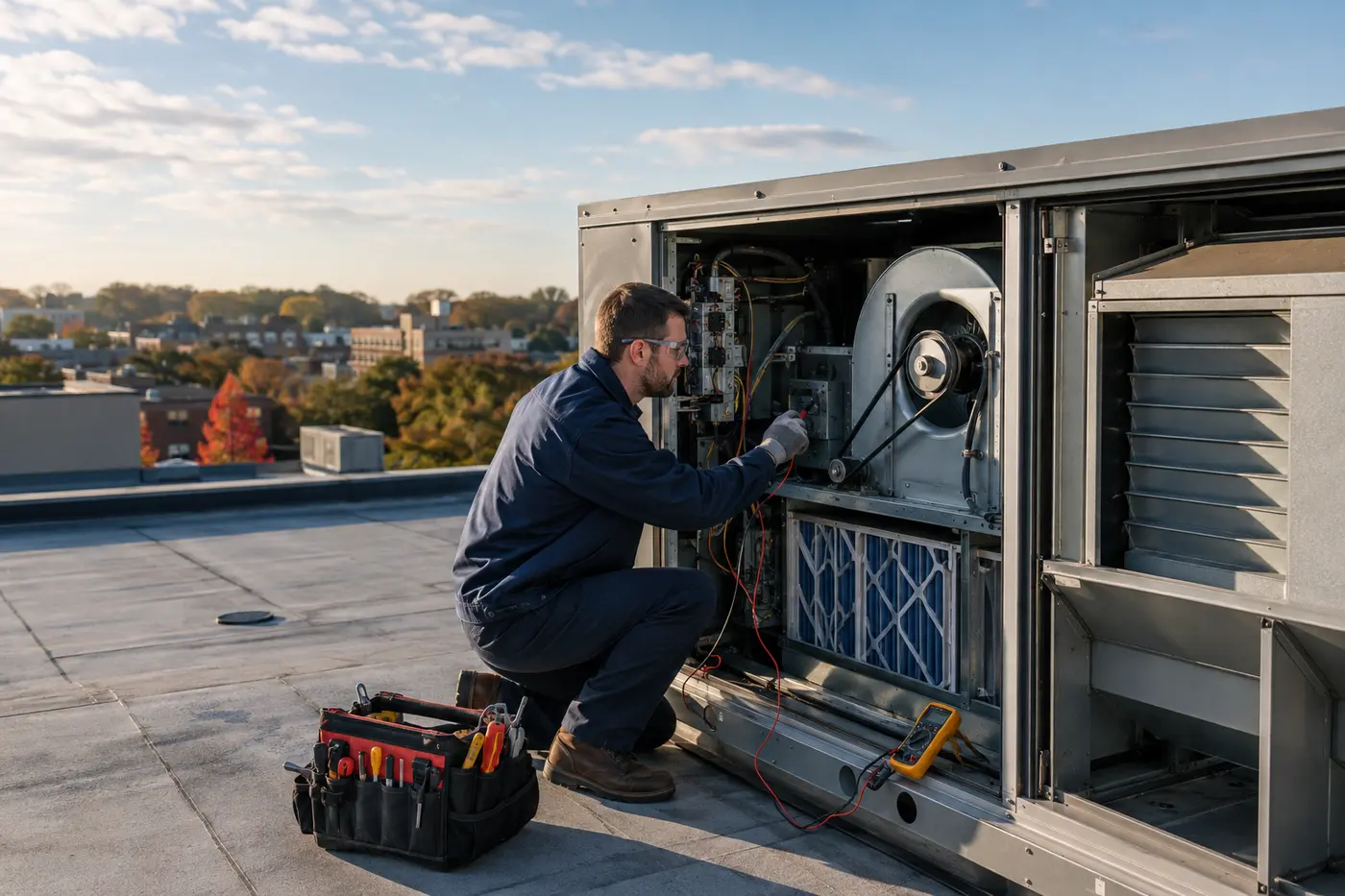
Commercial HVAC freeze damage rarely begins with one dramatic event. It often starts when cold air reaches a water-filled coil, circulation stops, a condensate line holds water, a damper does not close, or an unoccupied area loses heat without generating an alarm. A practical commercial HVAC freeze-protection checklist must therefore connect equipment condition, controls, fluid, drainage, building use, and response planning.
This guide is for facility and property managers responsible for commercial, mixed-use, hospitality, restaurant, club, and multi-family properties across Westchester County and New York City. Freeze protection is system-specific. Do not change glycol, bypass controls, energize heat tracing, or force equipment operation without confirming the installed design and qualified service requirements.
Start with the building, not the weather forecast. Identify every component that contains water or condensate and every location that can fall below its safe operating temperature. Include outdoor-air coils, hydronic coils, unit heaters, fan-coil units, make-up-air equipment, exposed piping, vestibules, loading areas, garages, roof and penthouse equipment, ceiling spaces near exterior walls, and seasonal areas with reduced occupancy.
Mark which protections each asset depends on: continuous circulation, heat input, glycol solution, insulation, approved heat tracing, damper position, airflow proving, low-temperature sensors, alarms, or manual winterization. If the facility team cannot state what protects a component, the protection should be verified before a hard freeze.
Review past incidents and near misses. Water stains, replaced coils, temporary pipe insulation, recurring low-temperature alarms, frozen condensate, or repeated space-heater use can reveal locations where the building has relied on luck rather than a durable sequence.
Water coils can be damaged when cold air reaches stagnant or inadequately protected fluid. Inspect coil casings, headers, valves, strainers, pumps, piping, insulation, vents, drains, and signs of previous leakage or distorted fins. Confirm that outdoor-air and mixing dampers travel to their commanded positions and seal as designed.
Verify circulation under every mode that is expected to protect the coil. A pump command does not prove flow. Check pump status, valve position, differential pressure or other available indicators, control sequence, and the response to a low-temperature condition.
Inspect pipe insulation for missing sections, compression, wetness, open seams, damaged vapor barriers, and penetrations. Insulation slows heat loss but does not replace circulation, heat, fluid protection, or controls. Pay special attention to valves, flanges, strainers, unions, gauges, vents, and short exposed sections that are often left incompletely insulated.
Hydronic heating reliability should also be reviewed before cold demand rises. The related commercial boiler maintenance checklist covers pumps, safeties, combustion, water condition, controls, and distribution.
Where a system uses glycol or another approved heat-transfer fluid, identify the fluid type and design requirement before testing. Record concentration or freeze point using a suitable method, but also review pH, inhibitor condition, contamination, color, clarity, and system history as applicable to the product and maintenance plan.
Do not assume that adding more glycol always improves protection. Fluid concentration affects viscosity, pumping energy, heat transfer, expansion, seals, and equipment performance. Mixing incompatible products or topping off with untreated water can create corrosion and reliability problems.
If testing identifies an unacceptable condition, the correction should address why the concentration or fluid quality changed. Leakage, repeated water makeup, improper service, contamination, or a failing component may continue to degrade the system after a simple adjustment.
Ask the service team to compare its recommendation with the equipment manual and fluid supplier’s requirements. Trane’s air-handler guidance illustrates why coil protection depends on the installed equipment and protective sequence.
Condensate traps, drain pans, hoses, pumps, and exterior drain terminations can freeze even when the heating system itself is operating. Standing water, poor slope, disconnected heat tracing, wind exposure, and low-load cycling increase the risk.
Inspect accessible pans and drains for debris, biological accumulation, corrosion, cracked fittings, sagging hose, inadequate support, and water remaining where the system should drain. Confirm that traps are configured for the installed pressure condition and that drain routes do not discharge where ice can create a slip hazard or block the outlet.
For heat pumps, VRF systems, and rooftop equipment, defrost water must leave the equipment safely. Ice accumulation around an outdoor unit can obstruct airflow, damage fans, redirect water into the building, or create a roof and walkway hazard. Do not chip ice from coils or use uncontrolled heat that can damage equipment.
Remove leaves, packaging, loose debris, and vegetation that restrict airflow or block drains while maintaining required clearances. Secure panels and inspect weather seals, access doors, cabinet penetrations, insulation, curb condition, and visible wiring or piping exposure.
Do not cover operating heat pumps or rooftop equipment unless the manufacturer and system design specifically require a procedure. Outdoor units need airflow and access. Snow and ice management should protect intakes, exhausts, combustion vents, condenser or heat-pump coils, and service paths without directing plowed snow or roof runoff into the equipment.
Fall rooftop maintenance should already have addressed filters, belts, coils, heat stages, economizers, dampers, drains, electrical components, and controls. Use the rooftop unit fall checklist to identify gaps that remain before freezing conditions.
For facilities with roof-mounted heating or cooling, include exposed drains, outdoor-air paths and protective sequences in the rooftop HVAC service review. Identify who will receive an alarm when the building is unoccupied.
Freeze protection depends on more than a sensor existing in the control diagram. Confirm sensor location, calibration, setpoint, wiring, alarm routing, reset method, and the sequence that should occur when the threshold is reached. Test low-temperature controls and interlocks according to the system design.
Verify that the protective action is physically possible. A controller cannot close a seized damper, create flow through a failed pump, or open a disconnected valve. Observe commanded and actual positions where available.
Review alarm escalation. A low-temperature alarm that reaches an unattended dashboard at 2 a.m. is not an effective response system. Confirm the responsible contact, notification path, access plan, decision authority, and instructions for protecting occupants and property.
Weekends, holidays, renovations, tenant vacancies, and seasonal closures change internal heat, equipment schedules, and staff presence. Review setback temperatures, exhaust operation, outdoor-air schedules, perimeter heat, garage or loading-area heat, pump operation, and remote alarms for these periods.
A deep setback can reduce energy use while increasing freeze risk in remote spaces. Evaluate the coldest vulnerable location rather than the average building temperature. Spaces near exterior walls, roof penetrations, loading doors, stairwells, and unused tenant areas may cool faster than the occupied core.
Document temporary operating changes and their end dates. Permanent overrides create hidden energy and reliability problems after winter conditions pass.
After a low-temperature alarm, loss of heat, visible ice, or sudden water release, do not assume the only task is thawing the component. Protect people and property, isolate the affected condition where authorized, and inspect the full water path.
Frozen coils and piping can split without leaking until ice begins to thaw. Qualified personnel should inspect coils, headers, piping, valves, fittings, drains, heat exchangers, controls, electrical components, ceilings, insulation, and adjacent finishes before returning the system to normal operation.
The final report should identify the failed protective layer: heat, circulation, fluid, insulation, drainage, damper, sensor, control sequence, alarm response, or operating procedure. Repairing the rupture without correcting the protective failure leaves the building exposed to the next freeze.
Plan a cold-weather review with Yukos Mechanical’s commercial HVAC maintenance team. We serve Lower Westchester first and review selected nearby commercial sites by location and scope.
Share the exposed equipment, current protective sequence, alarm history and operating schedule so the service team can confirm the review scope.
Request a Freeze-Protection ReviewRisk commonly involves water-filled coils, hydronic piping, condensate traps and drains, exposed valves and sensors, make-up-air equipment, cooling-tower or fluid-cooler piping, and equipment in unheated or lightly occupied spaces. Actual risk depends on design, location, fluid, controls, insulation, and operating condition.
No. Insulation slows heat loss but does not generate heat or guarantee protection during prolonged cold, loss of flow, control failure, or power interruption. Freeze protection may also depend on circulation, approved heat tracing, fluid condition, dampers, sensors, alarms, and operating sequences.
No. Fluid type and concentration must match the system design, materials, manufacturer requirements, climate, heat-transfer needs, and maintenance plan. Excessive or incorrect glycol can reduce performance and create other problems, so fluid condition should be tested and adjusted by qualified personnel.
Yes. A failed damper, fan, pump, valve, sensor, heat stage, low-temperature control, or airflow sequence can expose a coil or drain to freezing conditions while other parts of the building appear normal.
Do not simply restart equipment. Isolate the affected condition where authorized, protect the area from water damage, and have qualified personnel inspect coils, piping, valves, drains, heat exchangers, controls, electrical components, and surrounding materials before returning the system to service.
Our clients trust us for fast, reliable HVAC solutions—see their stories below!


Whether you’re planning a new system or just need service advice, our team is here to help—no pressure, no obligations.