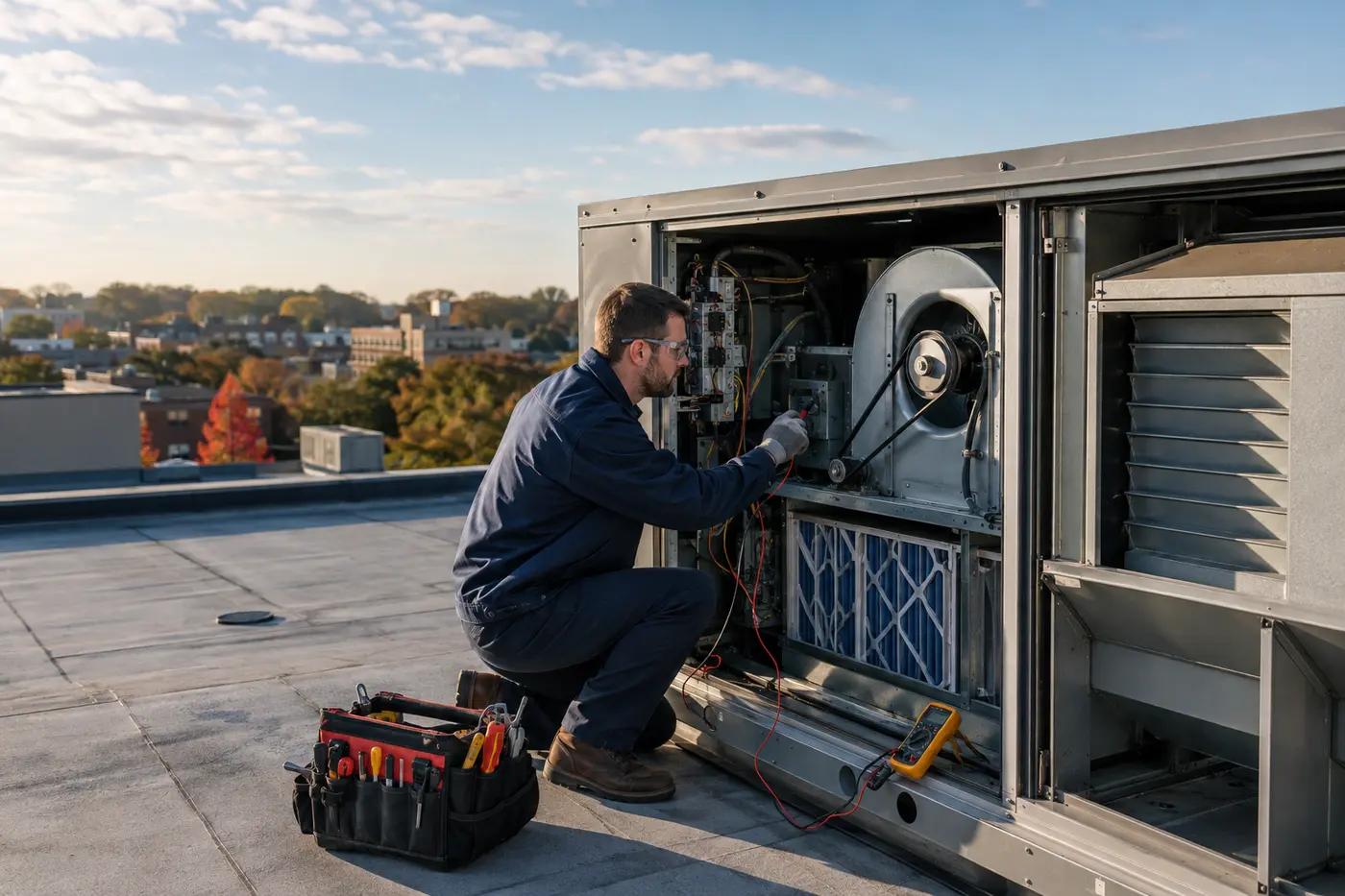
Rooftop unit maintenance for fall should prove that each RTU can switch from cooling to dependable heating before the first cold snap. Filters and belts matter, but so do economizers, dampers, drains, heat exchangers, ignition, controls, roof observations, and what occupants feel in the space below.
Commercial buildings across Westchester County and New York City often rely on packaged rooftop equipment that operates through hot, humid summers and then changes mode with little recovery time. A unit that finished the cooling season is not automatically ready for heating season—especially when summer service focused only on keeping the compressor running.
A fall RTU visit is successful only when the unit and the occupied zone are tested. “Fan runs” is not the same as verified heat, airflow, outside-air operation, drainage, controls, and safe combustion.
Before service begins, confirm which unit serves which space. Record or verify equipment IDs, locations, manufacturer, model, serial number, heating type, filter sizes, control system, accessories, and known complaints.
Not every rooftop unit has the same components. Some use gas heat, some electric heat, and others operate as heat pumps with auxiliary heat. Some use belts, pulleys, and serviceable bearings; newer direct-drive fan systems may not. Some have economizers, powered exhaust, smoke-control interfaces, or building-automation integration.
A checklist that assumes every RTU is identical will either miss real components or claim work that could not have been performed.
Commercial roof work requires appropriate access, weather conditions, fall protection, electrical safety, and coordination with the building. Property managers should confirm keys, ladders, roof hatches, escorts, parking, tenant notice, and shutdown authorization before the visit.
Technicians should be able to identify every unit without guessing. Matching the asset ID on the roof to the thermostat, control point, and occupied zone prevents the common failure of servicing the wrong unit while the original complaint remains unresolved.
Filters should be checked against the planned replacement interval and observed loading. The correct size, quantity, orientation, and fit matter. Gaps around a filter allow bypass; an overly restrictive filter can create airflow problems if the fan and duct system were not designed for it.
Fall service should also look beyond the filter:
Weak airflow can produce high-temperature-limit trips in heating mode, uneven space temperatures, long runtime, noise, and premature component stress.
For belt-driven equipment, inspect belt condition, tension, alignment, and pulley condition according to the manufacturer. Cracking, glazing, fraying, looseness, and misalignment should be documented and corrected under the approved scope.
Listen for bearing and motor noise, inspect mounting and vibration, and review current or other operating indicators when appropriate. A belt replacement without alignment or pulley review may only reset the failure clock.
If the RTU uses a direct-drive or electronically commutated fan system, the maintenance plan should reflect that design rather than listing nonexistent belts and bearings.
Outdoor and indoor coils should be inspected for dirt, damage, blockage, and evidence of improper prior cleaning. Cleaning method and chemicals must suit the coil and manufacturer; aggressive pressure or the wrong chemical can damage fins and coatings.
Inspect accessible drain pans, condensate outlets, traps, and lines. Standing water, biological buildup, rust, failed insulation, or an improperly configured trap can create leaks and indoor-air complaints. Even though cooling demand is declining, unresolved drainage problems should not be carried into winter and rediscovered during the next warm period.
Economizers and minimum-outdoor-air dampers often fail in positions that are not obvious from the occupied space. A damper stuck closed can reduce intended ventilation. A damper stuck open can cause cold drafts, excessive heating load, freezing risk, or humidity problems.
Fall testing should review, where equipped:
Do not assume an economizer works because the controller shows no alarm. Commanded position and actual damper movement should agree.
Qualified personnel should follow the manufacturer's procedures for ignition, burner operation, combustion, gas pressure where required, flame safeguard, heat exchanger, venting, limits, rollout protection, and temperature rise. Corrosion, overheating, delayed ignition, soot, or a failed safety requires corrective action—not a note to “monitor.”
Verify heating mode, reversing operation, outdoor fan, controls, defrost, and auxiliary or backup heat as applicable. A heat pump may cool properly but fail during heating changeover because the problem is in a component or control sequence that summer operation never called.
Inspect and test the heating stages, controls, airflow, safeties, electrical connections, and current draw or other manufacturer-specified indicators as appropriate. Low airflow can turn an electrical heating problem into repeated limit trips.
Check the thermostat or building-automation command against what the rooftop unit actually does. Confirm occupied schedules, temperature sensors, discharge or mixed-air sensors where present, staging, fan mode, alarms, and overrides.
Document overrides that remain active after summer troubleshooting. A temporary command that was never removed can prevent normal heating, economizer operation, or occupied scheduling.
HVAC technicians can document visible conditions around the unit, including loose panels, missing fasteners, damaged gaskets, ponding water, open penetrations, curb gaps, or flashing that appears deteriorated. That observation is not a roofing inspection and should not be presented as one.
When a roof or curb concern is visible, photograph it, identify the unit, note the location, and refer the property manager to a qualified roofing professional. Water entry can travel and may not originate where it appears inside the building.
A complete fall test should observe the sequence from the heating call through stable operation and shutdown. Depending on the unit, confirm:
Test long enough to reveal short cycling, limit trips, staging problems, or controls that fail after startup. A five-second burner observation is not a seasonal functional test.
Classify deficiencies so the owner can act:
If fall maintenance reveals a capital problem, use Yukos's commercial rooftop repair, retrofit, or replacement framework. That article addresses the decision intent; this checklist addresses seasonal maintenance.
Require the service report to identify the asset, space served, tasks completed, materials used, heating mode tested, key readings or observations, economizer and damper status, roof observations, deficiencies, photos, repair priority, and authorization status.
For buildings with multiple rooftop units, a one-line status table is valuable: ready for heat, ready after approved repair, limited operation, or out of service. That gives the property manager a portfolio view instead of a stack of disconnected technician notes.
Yukos Mechanical provides commercial rooftop HVAC maintenance and repair for offices, restaurants, retail spaces, clubs, schools, multi-family properties, and mixed-use buildings across Westchester County and New York City.
See Yukos's real rooftop HVAC project in New Rochelle and our New Rochelle HVAC service coverage, then schedule a fall RTU inspection before the first sustained heating call.
Verify airflow, dampers, heating components, controls, drainage, and occupied-zone response before winter demand exposes deferred problems.
Schedule Fall RTU ServiceFrequency should follow the manufacturer, equipment condition, runtime, filter loading, occupancy, environment, and maintenance plan. Seasonal heating and cooling tests are common, while filters or high-use equipment may require more frequent service.
The scope may include filters, airflow, fans, belts or direct-drive components, coils, drains, economizers, dampers, heating equipment, ignition, heat exchangers, safeties, sensors, controls, roof observations, and a complete heating-mode test.
No. Many rooftop units use belt-driven fans, while some newer designs use direct-drive or electronically commutated fan systems. The checklist should match the actual unit instead of claiming the same belt and bearing work for every asset.
A damper stuck closed can reduce intended ventilation, while one stuck open can create cold drafts, excess heating load, freezing risk, or control problems. Testing should compare commanded position with actual damper movement.
A technician can document visible curb, flashing, panel, penetration, and ponding concerns, but that is not a roofing inspection. Suspected roof or flashing defects should be evaluated and repaired by a qualified roofing professional.
Our clients trust us for fast, reliable HVAC solutions—see their stories below!


Whether you’re planning a new system or just need service advice, our team is here to help—no pressure, no obligations.