
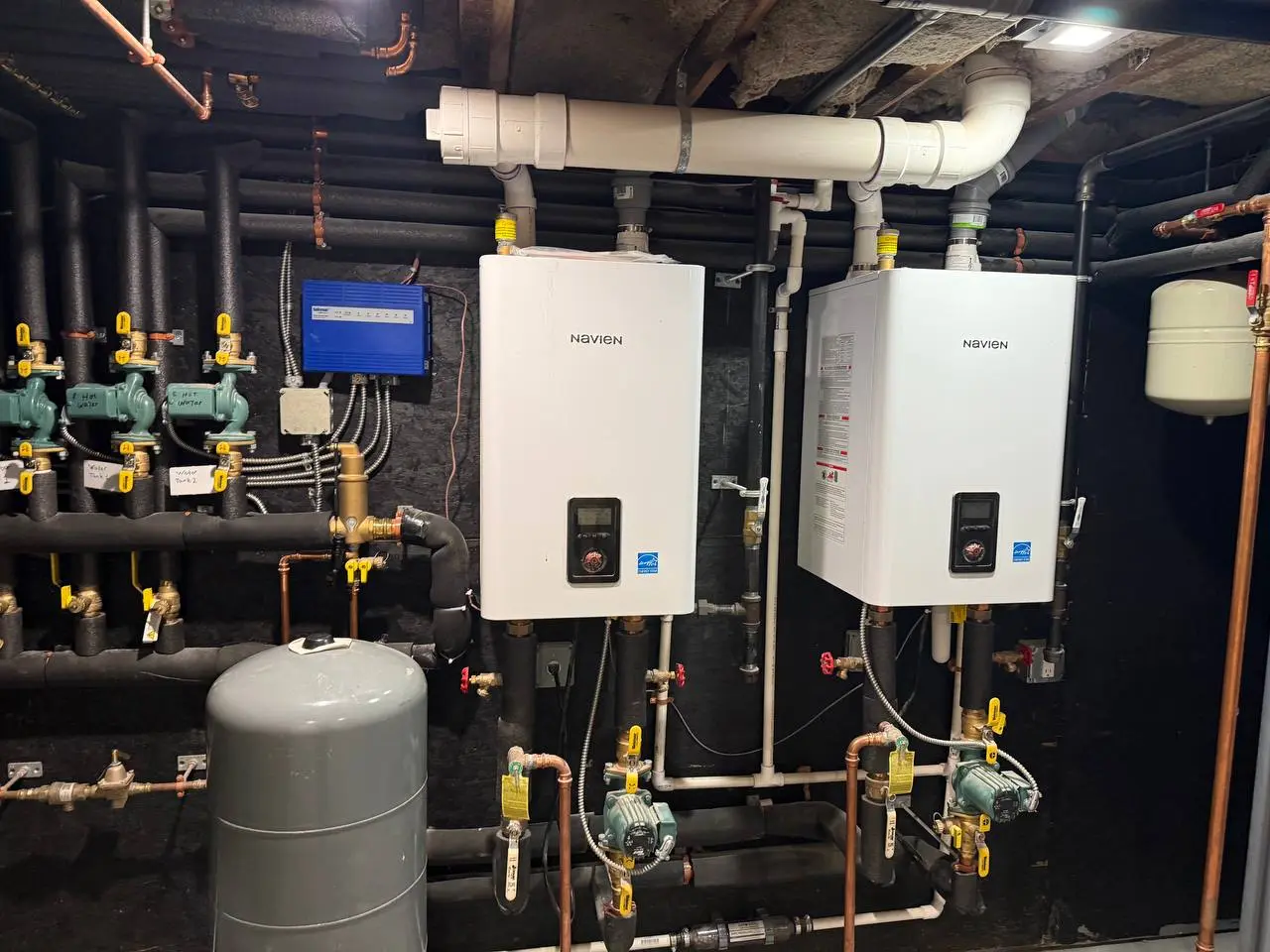
The first clue might be a shower that runs lukewarm halfway through, or a heating zone that takes much longer to warm up than it did last winter. Mineral buildup inside a heat exchanger is one possible cause. The most useful clue for your technician is where the change shows up and what the system was doing when it happened.
This guide is for homeowners and property managers in Lower Westchester who want to know when to request an inspection, what a professional descaling visit should include, and how to document the result. For routine service, see our high-efficiency boiler maintenance service.
A heat exchanger moves heat across metal surfaces. In a fuel-burning appliance, the primary exchanger transfers heat from combustion to water. Some combination boilers use a separate plate heat exchanger to transfer heat from the boiler circuit to the domestic water that goes to taps and showers.
Calcium and other minerals in hard water can build up as water is heated. Over time the deposits can coat metal surfaces and narrow water passages. That can reduce heat transfer or restrict flow. The rate of buildup varies with water chemistry, temperature, usage, and the design of the appliance. Navien explains how scale affects tankless water heaters.
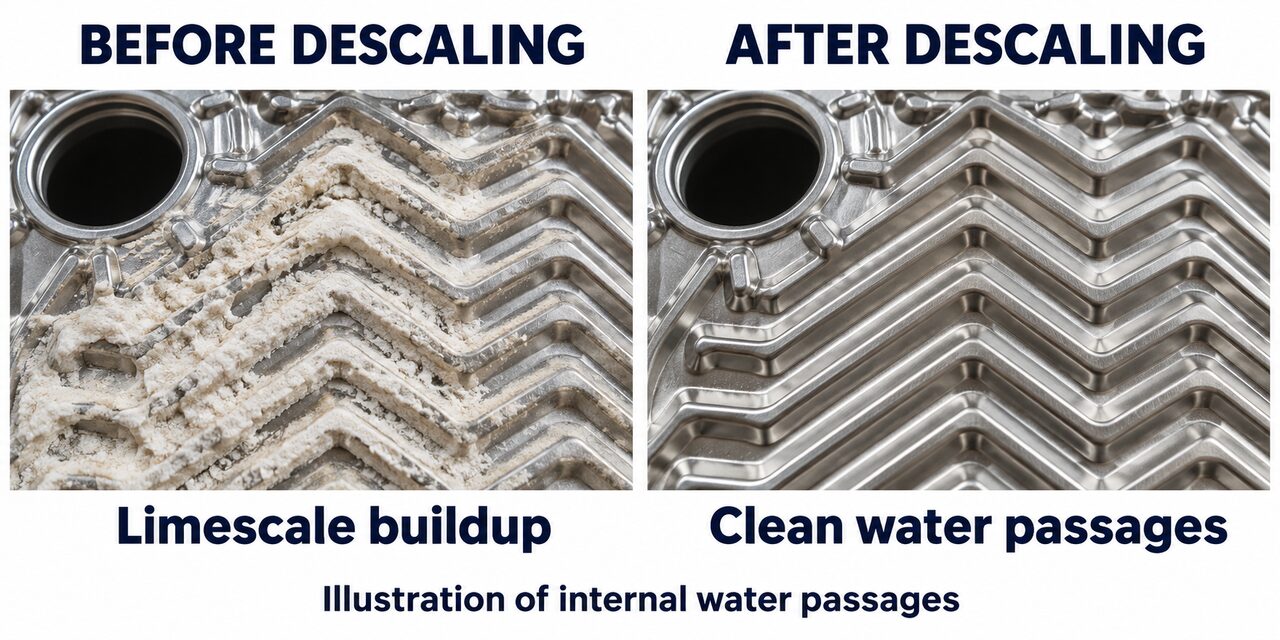
For a photographed example, Apex Engineering shows a plate-and-frame exchanger and a shell-and-tube exchanger before and after industrial cleaning. The pictures show how deposits cover surfaces and openings. A service report can document what was actually found on your equipment and how the appliance operated afterward.
Record when a symptom began and whether it occurs every time, after several minutes of use, or only when demand is high. A description such as “the water cools off when two showers are running” gives a technician a condition to reproduce.
A useful service note: “The second-floor showers lose temperature after about five minutes when both are running. The radiators are heating normally. The last recorded service was in September.” That gives the technician a starting point for a repeatable test.
A tankless water heater heats domestic water as you use it. For this equipment, the service question is whether the water path needs descaling, and how often the model and local water conditions call for it. Navien recommends at least annual descaling for its tankless water heaters, with frequency depending on conditions and use.
A combi boiler supplies space heating and domestic hot water. Share whether the problem affects heating, hot water, or both. The service scope should name the affected circuit and the exchanger or other component the technician plans to inspect.
A heating-only boiler circulates water through radiators, baseboards, or radiant floors. It may also serve an indirect water heater through a separate zone. Ask the technician to review the heating-loop water condition, pressure history, and whether the system has needed frequent makeup water. The findings help determine whether the loop or exchanger needs treatment. See our Navien guide to combustion-side cleaning and water-side descaling for a closer look at the different procedures.
A clear work order identifies the equipment, the symptoms, and the component under review. Ask the technician what they will check before recommending a flush. The exact steps depend on the model, its condition, and whether service valves provide access.
For multiple units, ask for the report by model or equipment number. If a building has two boilers, confirm which appliance was tested and serviced. Our Rye multifamily boiler installation shows how two boilers can share a mechanical room. The commercial boiler checklist covers building-wide preparation, access, and service records.
Removing deposits when the manufacturer’s procedure and the equipment condition call for it can help maintain flow, heat transfer, and reliable operation. Addressing restrictions early can also help reduce the risk of premature failure. The benefit depends on the equipment’s age, water conditions, installation, and operating history.
For fuel-burning equipment, annual professional inspection is also a safety measure. The U.S. Consumer Product Safety Commission recommends yearly inspection of fuel-burning home heating systems and their vents. Ask what combustion and venting checks are included in your appointment. If a carbon monoxide alarm sounds, get everyone outside and call 911 from a safe location. If you smell gas, leave and call the gas utility or 911 from outside.
Have the service address and ZIP code, the make and model, an accessible rating-label photo, the last maintenance date, and a short description of what changed. For a building, include the unit count, the affected floors or tenants, and any limits on interrupting heat or hot water. If you have a maintenance plan, send the current scope so the office can check what is covered.
Yukos Mechanical can review your equipment and symptoms and confirm whether the next step is routine maintenance or a diagnostic visit. Send a service request or call (845) 300-6653 to discuss scope, price, and availability.
Share the model, service address, and what changed with your heat or hot water. We’ll confirm the appropriate visit and scope.
Request Boiler ServiceReduced hot-water flow or unstable temperature can justify checking for water-side restrictions. A technician can use the affected fixtures, fault history, and operating measurements to determine whether scale is contributing.
It depends on the appliance and which circuit is affected. A combination boiler serves both needs, and an issue on the domestic-hot-water side can show up at the taps while the rooms still heat normally.
Follow the schedule for the exact model. Navien recommends at least annual descaling for its tankless water heaters. For a heating boiler, the manufacturer’s procedure, water quality, and observed condition guide the need for flushing.
Removing deposits when indicated can help protect flow and heat transfer and reduce the risk of premature failure. The expected service life depends on the equipment and its operating conditions.
Ask which circuit and component will be treated, what checks are included before and after service, whether any materials or parts are billed separately, and what findings will appear on the service report.
Our clients trust us for fast, reliable HVAC solutions—see their stories below!


Whether you’re planning a new system or just need service advice, our team is here to help—no pressure, no obligations.