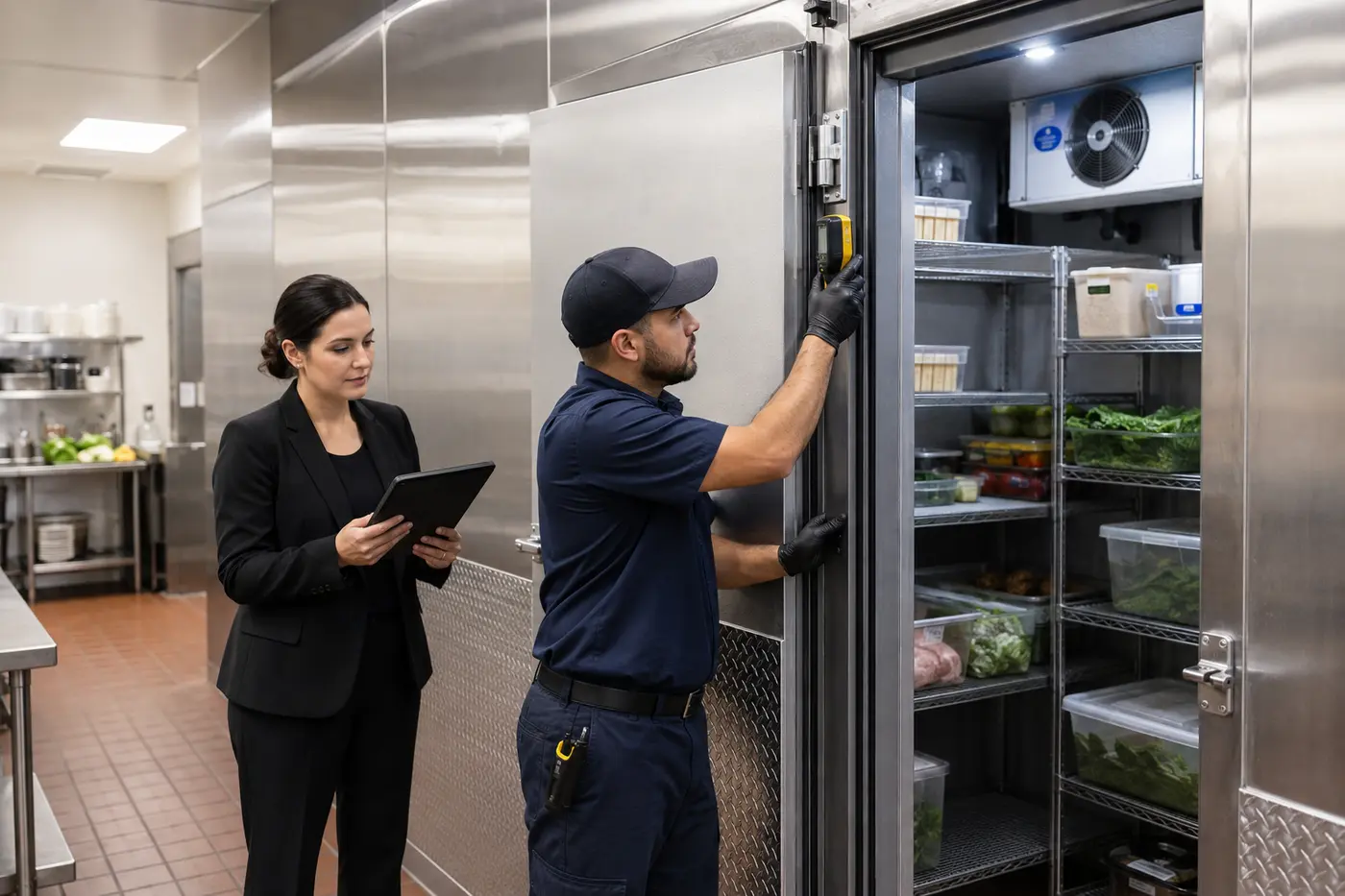
Walk-in cooler maintenance protects more than a refrigeration system. It protects food inventory, kitchen continuity, inspection readiness, and the hours a manager has to respond before a temperature problem becomes a loss event.
Restaurant operators and food-service property managers across Westchester County and New York City should enter the fall event and holiday season with clean condensers, intact door seals, reliable temperature records, working fans and drains, and a clear emergency response plan. Maintenance cannot eliminate every breakdown, but it can expose the warning signs that are expensive to discover during dinner service.
Use two checklists: an operator checklist for temperature, doors, ice, alarms, and housekeeping; and a professional commercial refrigeration maintenance checklist for electrical, refrigerant, fan, coil, defrost, control, and performance diagnostics.
A wall display or controller reading is one data point. It may not represent product temperature, the warmest location, the effect of a recent delivery, or the condition after repeated door openings.
Build a written or digital logging procedure that defines:
The 2022 FDA Food Code uses 41°F or less for cold holding of many time/temperature control for safety foods, and the Westchester County Health Department advises keeping refrigerator internal temperature at 41°F or below. Operators must follow the requirements of their health department, approved food-safety plan, and the products they store.
If product safety may be affected, the correct response is not only an HVAC service call. Follow the facility's food-safety procedure, protect or relocate inventory when appropriate, document time and temperature, and involve the person responsible for food-safety decisions.
Restaurant staff are close to the equipment every day. Give them a checklist that takes minutes and produces useful evidence.
A checklist is useful only when staff know whom to call and what to do with product. Put the escalation contacts and response steps beside the log.
The condenser rejects heat from the refrigerated space. Dust, grease, lint, and blocked airflow make that job harder, increasing operating pressure, runtime, energy use, and component stress.
Commercial kitchens can load coils faster than a generic calendar assumes. Inspection and cleaning frequency should reflect the actual environment. A remote outdoor condenser, a unit above a hot kitchen, and equipment next to laundry or cardboard dust may need different schedules.
Qualified service should use cleaning methods suitable for the coil and equipment. High pressure, harsh chemicals, or cleaning without protecting electrical components can cause damage. After cleaning, verify fan operation and condenser airflow rather than treating visual improvement as proof of performance.
A damaged gasket or door that does not close creates continuous warm, humid air infiltration. The result can be longer runtime, frost, slippery floors, temperature instability, and unnecessary load on the refrigeration system.
Check the full perimeter for gaps, tears, hardened sections, loose retainers, and food debris. Inspect hinges, latches, closers, sweeps, and thresholds. The repair should address why the door is misaligned; replacing a gasket alone will not solve a sagging hinge or damaged frame.
Staff should avoid propping the door open during deliveries. When extended access is operationally necessary, plan the delivery, use strip curtains or other approved controls where appropriate, and monitor recovery afterward.
Ice on an evaporator, ceiling, floor, suction line, or door is not one problem with one fix. It may relate to air infiltration, blocked airflow, a failed fan, drain trouble, defrost controls, heaters, sensors, refrigerant performance, or door use.
Do not attack ice with knives, screwdrivers, or unapproved heat. That can puncture coils, damage wiring, injure staff, and create a refrigerant or electrical emergency.
Record where the ice forms, how quickly it returns, whether all fans operate, and what the temperature trend shows. Commercial refrigeration repair should correct the cause, not only remove the ice.
Evaporator fans move air through the coil and around the cooler. A failed motor, damaged blade, ice obstruction, loose guard, or product stacked too close to the coil can create warm pockets even when the controller appears normal.
During professional service, inspect fan operation, noise, vibration, guards, wiring, and airflow. Staff should know that a silent fan or sudden change in airflow is a reportable condition—not background kitchen noise.
Defrost water must leave the evaporator pan and drain system. Blockage, poor slope, failed heat trace where required, damaged insulation, or biological buildup can cause overflow, ice, odors, and slip hazards.
Inspect the drain pan, line, trap, termination, and heat components applicable to the system. Do not pour unapproved chemicals into the drain. Cleaning and treatment methods should suit the equipment, food environment, and local requirements.
Defrost problems can look like refrigerant problems, door problems, or simple ice buildup. Service should review the configured schedule or demand logic, termination, fan delay, heaters or hot-gas components where applicable, sensors, and the way the system returns to cooling.
Check temperature probes against an appropriate reference and review alarm history. Test that remote alarms reach the correct person during nights and weekends. An alarm sent to an inactive email address is not an alarm system.
After service, record setpoints and control changes. Undocumented adjustments can make the next diagnosis harder and may create unintended product-temperature swings.
Possible warning signs include declining capacity, longer runtime, uneven frost patterns, repeated low-pressure trips, oil staining near joints, bubbles in a sight glass where relevant to the system and operating condition, or a hissing sound. None of these alone proves a leak, and refrigerant should not be added based on a guess.
Only properly certified personnel should connect gauges, recover refrigerant, open the sealed system, or repair a leak. The EPA's Section 608 guidance explains federal leak-repair requirements for certain covered appliances; owners should verify the rules that apply to the refrigerant, charge, and equipment.
Repeatedly adding refrigerant without finding the cause is not preventive maintenance.
Use the emergency plan when:
The restaurant's response should run on two tracks: protect food and operations under the approved food-safety plan, while qualified commercial refrigeration technicians diagnose the equipment.
For every walk-in cooler and freezer, keep:
This record lets an operator see whether the problem is a one-time component failure or a recurring pattern that deserves redesign, replacement, or a different maintenance frequency.
Commercial refrigeration does not operate in isolation. Kitchen heat, exhaust, makeup air, room temperature, grease, door traffic, storage practices, and electrical reliability all affect performance.
Our guide to brewery HVAC, ventilation, and humidity control shows why hospitality mechanical systems must be evaluated as a connected operating environment. You can also review Yukos's real hospitality HVAC project in White Plains.
Yukos Mechanical supports restaurants and commercial properties with commercial HVAC and mechanical service across Westchester County and New York City, with select coverage in northern New Jersey and Fairfield County, Connecticut.
Request a refrigeration-readiness assessment to review equipment condition, temperature controls, condenser and evaporator performance, drainage, alarms, and repair priorities before a weekend or holiday exposes the next weak point.
Review temperatures, coils, doors, fans, drains, controls, alarms, and emergency procedures before a weekend or holiday exposes the next failure.
Request Refrigeration ServiceOperators should monitor temperatures, doors, ice, airflow, alarms, and housekeeping routinely. Professional frequency should reflect manufacturer instructions, kitchen grease and dust, runtime, coil loading, equipment condition, and repair history.
Many time and temperature control for safety foods are held at 41°F or less under the FDA Food Code. Operators must follow their health department, approved food-safety plan, product requirements, and a defined procedure for measuring and responding to temperature.
Ice may result from air infiltration, a door problem, blocked airflow, failed fans, drain trouble, defrost controls or heaters, sensors, or refrigeration-system performance. Removing ice without diagnosing the cause usually allows it to return.
Dust, grease, and blocked airflow reduce the condenser's ability to reject heat. That can increase operating pressure, runtime, energy use, component stress, and the risk of a refrigeration failure during busy periods.
Request urgent help when temperatures rise outside the approved range, fans or the condensing unit stop, a breaker or safety repeatedly trips, there is smoke or a burning smell, ice blocks airflow, water threatens electrical components, or a refrigerant leak is suspected.
Our clients trust us for fast, reliable HVAC solutions—see their stories below!


Whether you’re planning a new system or just need service advice, our team is here to help—no pressure, no obligations.