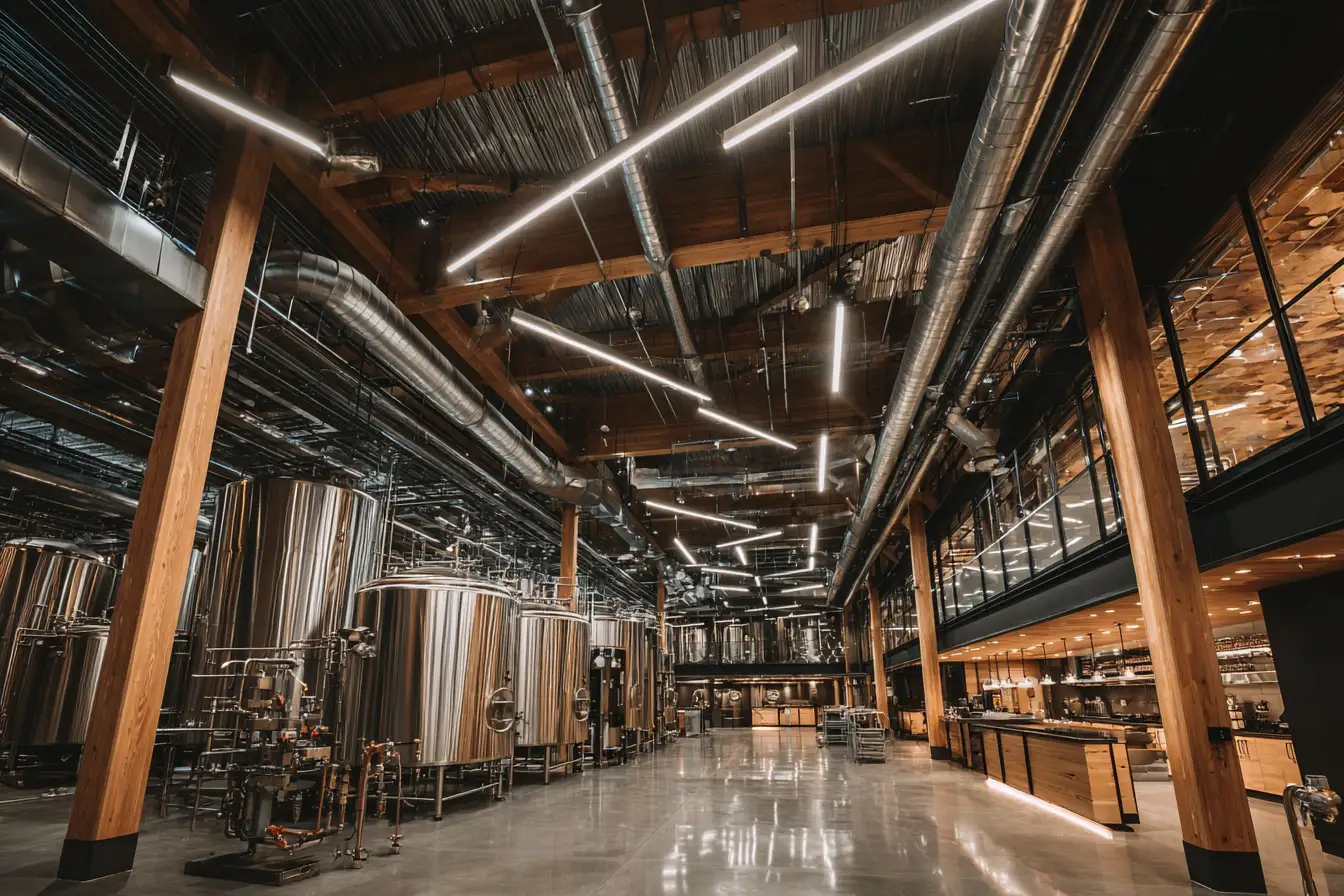
Designing HVAC systems for breweries requires far more than standard commercial heating and cooling. Brewing facilities produce heat, steam, humidity, odors, and CO2 while also requiring precise temperature control for production, storage, packaging, and customer-facing spaces.
Across White Plains and Westchester County, many breweries operate inside converted warehouses, older commercial buildings, mixed-use properties, and industrial spaces. These buildings often create HVAC design challenges involving ventilation capacity, duct routing, roof access, electrical infrastructure, ceiling height, humidity control, and energy efficiency.
A properly designed brewery HVAC system supports product quality, employee safety, customer comfort, equipment reliability, and long-term operating efficiency. Poor HVAC design can lead to excessive condensation, uncomfortable taprooms, inconsistent fermentation temperatures, mold risk, corrosion, high utility bills, and production interruptions.
Commercial facilities with heavy ventilation needs may also benefit from reviewing our guide to commercial gym HVAC system design and ventilation efficiency, since both facility types require high outdoor-air management and stable indoor comfort.
Breweries operate under environmental conditions that standard commercial HVAC systems are not designed to handle without careful planning.
Common brewery HVAC loads include:
Without proper HVAC design, these conditions can create inconsistent product quality, unsafe working conditions, excessive energy use, and premature equipment wear.
Temperature control is one of the most important aspects of brewery HVAC design. Different areas of the facility often require different temperature targets depending on how the space is used.
Fermentation spaces require consistent environmental control because temperature swings can affect product consistency and brewing outcomes.
These areas may require dedicated zoning, process cooling coordination, and controls that are separate from customer comfort systems.
Cold rooms, keg storage areas, and packaging spaces often require lower temperatures than production or taproom areas.
HVAC design should account for door openings, product movement, equipment heat, and humidity control to maintain stable conditions.
Systems such as water source heat pump systems can be effective in multi-zone commercial environments because they support flexible temperature control across different operational spaces.
Ventilation is one of the most critical components of brewery HVAC design. Brewing processes release heat, steam, odors, and gases that must be controlled safely and efficiently.
Effective ventilation helps:
Brewery ventilation must be designed around both production and occupancy. A system that works for a taproom may not be sufficient for boiling, fermentation, cleaning, or packaging areas.
High-capacity exhaust systems, make-up air units, dedicated outdoor air systems, and carefully balanced supply airflow are often required to maintain safe and comfortable conditions.
Brewing generates significant moisture. If that moisture is not controlled, it can lead to condensation, mold growth, corrosion, odors, and structural damage.
Common humidity challenges include:
Humidity management requires more than simply adding cooling. Proper system design may include dehumidification, exhaust balancing, insulated ductwork, vapor control, drainage planning, and dedicated ventilation zones.
Many of these strategies overlap with broader commercial HVAC approaches used in high-humidity facilities and high-ventilation environments.
Ductwork in breweries must handle higher airflow volumes, moisture exposure, and challenging building layouts.
Important ductwork considerations include:
Because many breweries operate in retrofitted buildings, duct design often requires creative routing around structural beams, low ceilings, existing utilities, and roof constraints.
Facility owners planning airflow upgrades should review our guide to commercial HVAC ductwork design and airflow.
Breweries are energy-intensive facilities. Between brewing equipment, refrigeration, ventilation, lighting, and customer spaces, energy costs can become significant without efficient HVAC design.
Breweries rarely have one consistent load profile. Production areas, cold storage, offices, and taprooms may all operate on different schedules.
Smart controls help reduce wasted energy by matching HVAC output to actual occupancy, production demand, and ventilation needs.
Commercial owners focused on reducing operating costs may also benefit from our guide to energy-saving HVAC techniques.
Many breweries are built inside converted commercial, warehouse, or light-industrial spaces. These buildings often create design limitations that must be addressed during HVAC planning.
Common retrofit challenges include:
Successful retrofit projects require careful coordination between HVAC design, building layout, production equipment, code requirements, and long-term maintenance access.
Indoor air quality is essential in breweries because production areas can generate heat, moisture, odors, and CO2.
Important safety and air quality strategies include:
Maintaining indoor air quality helps protect workers, customers, equipment, and product consistency.
Brewery HVAC systems operate in demanding environments and require routine preventative maintenance.
Key maintenance tasks include:
Preventative maintenance helps reduce downtime, protect equipment, and maintain stable production conditions.
The ideal HVAC system depends on the brewery’s size, production volume, layout, customer areas, and long-term growth plans.
Design should account for:
Commercial properties in Westchester communities such as White Plains HVAC services often require tailored HVAC design because older commercial spaces may not have been originally built for production use.
Brewery HVAC design should never be treated like standard office HVAC. Production heat, moisture, ventilation loads, CO2 management, and zoning requirements must be engineered together for reliable long-term performance.
Breweries require specialized HVAC systems that balance process cooling, ventilation, humidity control, air quality, and customer comfort. In Westchester County, where many breweries occupy retrofitted commercial spaces, HVAC design must account for both production demands and existing building limitations.
A properly designed system can improve energy efficiency, protect product quality, support worker safety, reduce moisture problems, and help the facility operate reliably through changing seasonal conditions.
Yukos Mechanical helps commercial property owners throughout Westchester County evaluate complex HVAC requirements, design efficient ventilation systems, and support reliable performance for production-focused facilities. Contact Yukos Mechanical to schedule a commercial HVAC consultation today.
Ensure consistent production, air quality, and efficiency with a properly designed system.
Get Expert ConsultationBreweries generate heat, steam, humidity, odors, and CO2 while requiring precise temperature control across production, storage, and customer areas.
Common issues include poor ventilation, excessive humidity, condensation, uneven temperatures, CO2 concerns, equipment corrosion, and high energy use.
Stable temperature, humidity, and ventilation help support consistent production conditions, protect equipment, and reduce environmental fluctuations that can affect brewing operations.
Some standard commercial equipment may be used, but brewery applications typically require customized zoning, ventilation, humidity control, and exhaust design.
Brewery HVAC systems should be inspected regularly because moisture, process heat, exhaust loads, and continuous operation can accelerate wear and reduce performance.
Our clients trust us for fast, reliable HVAC solutions—see their stories below!


Whether you’re planning a new system or just need service advice, our team is here to help—no pressure, no obligations.