Holiday restaurant traffic compresses more operating hours, door openings, product loading, kitchen exhaust, and guest expectations into a period when outside temperatures are falling. A useful restaurant holiday HVAC and refrigeration readiness plan must therefore protect three connected operating conditions: food-storage temperatures, kitchen air balance, and occupied-space comfort.
This guide is for restaurant owners, operators, facility managers, and hospitality groups across Westchester County and New York City. It focuses on the mechanical systems Yukos services. Kitchen hood cleaning and fire-suppression inspection are separate specialties and must remain on their required schedules.
A restaurant may operate acceptably during ordinary weekdays and struggle during holiday service. Deliveries increase cooler loading. Doors open more frequently. Kitchens run longer. Exhaust demand rises. Dining rooms fill. Outdoor air is colder, and occupied schedules may extend beyond their normal programming.
These conditions expose marginal components and control sequences. A dirty condenser, restricted evaporator airflow, weak door closure, partial drain blockage, slipping belt, failed heating stage, incorrect schedule, or unreliable sensor may not cause an immediate shutdown during light operation. Under sustained demand, the same condition can become a temperature alarm, cold dining room, kitchen-pressure complaint, or service interruption.
The correct goal is not to declare every unit “working.” It is to verify that critical systems can operate through representative conditions and to resolve known deficiencies while approval and parts time still exist.
Begin with data. Review temperature logs, controller alarms, remote-monitoring history, prior service reports, product-loading patterns, door complaints, icing, drain incidents, water on the floor, unusual noise, and any equipment that required repeated resets.
Separate air temperature, product temperature, and controller display. A brief air-temperature rise after loading or door opening does not necessarily describe product condition, while a stable display does not prove that every part of the box is performing correctly. The restaurant’s food-safety procedures and applicable requirements should determine how temperatures are monitored and escalated.
Identify critical equipment and redundancy. If one walk-in serves all high-value product with no alternate storage, even a moderate unresolved deficiency may deserve higher priority than a similar issue on equipment with backup capacity.
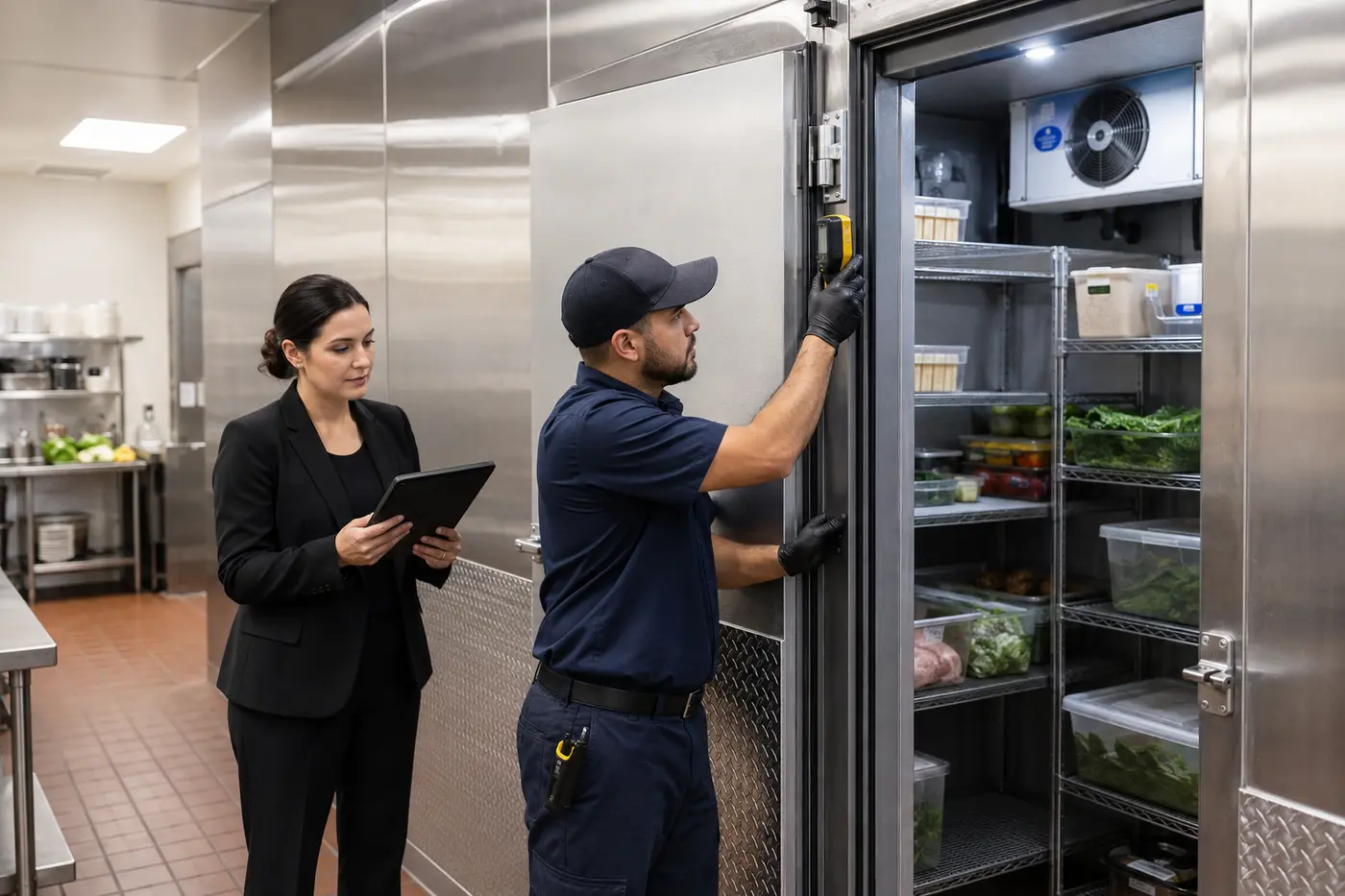
Refrigeration reliability depends on heat transfer, airflow, controls, drainage, enclosure condition, and operating practice. Inspect door closers, hinges, sweeps, gaskets, thresholds, latches, strip curtains where used, and evidence of warm-air infiltration. A door that does not seal adds load every minute it remains misaligned.
Check the evaporator area for blocked airflow, damaged fan guards, abnormal ice patterns, dirty surfaces, drain-pan condition, and signs of repeated freeze-up. Inspect the condenser location for restricted airflow, grease or debris accumulation, fan condition, vibration, and access limitations. Record—not merely remove—unusual frost or water patterns because they can help distinguish airflow, defrost, drain, control, refrigerant, or enclosure problems.
Qualified refrigeration service may include pressure, temperature, electrical, superheat, subcooling, defrost, fan, heater, sensor, and control checks appropriate to the installed system. Refrigerant should not be added simply because cooling performance is poor; the system must be diagnosed and any leak-related work handled in accordance with applicable requirements.
Our walk-in cooler maintenance and commercial refrigeration guide provides a deeper equipment-focused checklist.
Holiday readiness cannot stop at refrigeration. Kitchen exhaust removes large volumes of air, and the building must replace that air in a controlled way. When make-up air is unavailable, unheated, incorrectly scheduled, or poorly balanced, the restaurant may experience hard-to-open doors, cold drafts, odor migration, weak hood capture, and heating systems that run continuously without stabilizing occupied areas.
Inspect accessible belts, filters, fans, dampers, heaters, discharge conditions, and interlocks. Test exhaust and replacement air together under a representative cooking condition. Review occupied schedules, fan proving, heating stages, discharge-air control, freeze protection, and the relationship between kitchen, dining, entry, restroom, and adjacent tenant exhaust.
Do not compensate for pressure problems by making an arbitrary damper adjustment. Air quantities, hood performance, equipment requirements, and building pressure must be measured and evaluated together. Our commercial ventilation and make-up air service covers how these systems are evaluated together.
Guest comfort complaints can involve the heating equipment, but they may also result from door infiltration, exhaust imbalance, poor air distribution, failed perimeter heat, thermostat location, or schedules that do not match extended operating hours.
Map representative temperatures rather than relying on one thermostat. Check entry areas, perimeter seating, private rooms, restrooms, waiting areas, kitchens, offices, and storage spaces with freeze-sensitive piping. Note when complaints occur: opening, dinner rush, after a large exhaust fan starts, or near closing when a schedule changes.
Professional heating checks should reflect the installed system. Rooftop units may require heating-stage, airflow, economizer, damper, ignition, combustion, and control testing. VRF and heat-pump systems may require indoor-unit, outdoor-unit, defrost, fault-history, airflow, and zone-communication checks. Boilers and hydronic systems require their own temperature, pressure, pump, valve, safety, and distribution evaluation.
Holiday hours often differ from standard schedules. Review every relevant controller, time clock, thermostat, building-management schedule, refrigeration alarm route, and remote-monitoring contact. Confirm that temporary events, late service, deliveries, and prep periods do not occur while equipment remains in setback or unoccupied mode.
Test alarms rather than assuming they reach the correct person. Verify contact names, phone numbers, escalation order, after-hours access, and who has authority to move product, approve service, or call a backup vendor. Remove former employees and outdated contacts from the chain.
Avoid leaving permanent overrides in place after the holiday period. Document every temporary schedule and the date it should return to normal.
Mechanical readiness and operating discipline reinforce each other. Confirm that deliveries do not block evaporator airflow, hot product is handled according to the food-safety plan, doors close completely, cartons do not damage gaskets, and staff report alarms instead of silencing them.
Keep equipment access clear. Technicians should be able to reach condensing units, electrical disconnects, controllers, roof hatches, mechanical rooms, evaporators, and drains without moving holiday inventory or waiting for a missing key.
Prepare a contingency plan for critical refrigeration. Identify alternate approved storage, product-disposition authority, alarm escalation, site contacts, and the equipment information a service provider will need. This planning does not replace repair; it reduces confusion if a failure occurs during a high-volume shift.
Keep food-safety decisions with the person in charge. If a cooler cannot maintain the conditions required by the restaurant’s food-safety plan, follow that plan and the applicable local rules for product handling while a technician evaluates the equipment. The FDA Food Code is a model reference. A restored equipment display does not establish the prior temperature history of stored food.
The report should identify every inspected asset, its operating status, measurements taken, cleaning or adjustment performed, unresolved deficiencies, recommended repair, parts requirement, and priority. Separate routine maintenance from corrective work so restaurant management can see what was completed and what still requires authorization.
For refrigeration, document temperature and control findings, coil and airflow condition, door and gasket issues, drainage, defrost, alarms, and any refrigerant-system concern. For ventilation and heating, document fan and belt condition, air balance observations, heating stages, safeties, schedules, controls, and affected spaces.
Close the visit with one of three clear outcomes: ready for expected demand, operating with a monitored limitation, or not ready pending corrective work. Vague language transfers risk back to the operator without helping the decision.
Discuss walk-in refrigeration, heating and commercial ventilation for your property. Yukos Mechanical reviews requests in Lower Westchester and selected nearby commercial locations.
Verify refrigeration, kitchen air balance, heated make-up air, occupied-space comfort, controls, alarms, and holiday schedules before peak service.
Request Restaurant HVAC and Refrigeration ServiceSchedule enough time before peak reservations and events to diagnose deficiencies, obtain approval, order parts, complete repairs, and verify operation. A last-minute checklist has limited value if corrective work cannot be completed before the busy period.
Review temperature and alarm history, door closure and gaskets, evaporator and condenser condition, airflow, drain performance, frost or ice patterns, fan operation, controls, and the condition of accessible refrigeration components. System-specific readings should be taken by qualified refrigeration personnel.
Kitchen exhaust removes large volumes of air. If heated replacement air and building pressure are not coordinated, cold outdoor air can enter through doors and leaks, causing drafts, odor migration, poor hood capture, and additional heating demand.
Setpoints should not be changed casually to compensate for loading, airflow, maintenance, or door-management problems. Review the equipment design, food-safety plan, product requirements, control calibration, and actual temperature trends before making changes.
No. HVAC and refrigeration service may cover make-up air, exhaust-fan operation, heating, cooling, controls, building pressure, and refrigeration equipment. Hood cleaning and fire-suppression inspection are separate specialized services and should remain on their own required schedules.
Our clients trust us for fast, reliable HVAC solutions—see their stories below!


Whether you’re planning a new system or just need service advice, our team is here to help—no pressure, no obligations.