
A heated driveway can make winter access easier, especially when a custom home has a sloped approach, a shaded garage entrance or a driveway the owner wants to use without waiting for a snow-clearing visit. The right system starts with the property and the construction plan—not simply a boiler and a length of tubing.
This guide explains how residential snow-melt systems work, when hydronic driveway heating is worth considering, what drives installation and operating costs, and what to ask before requesting a proposal. It also looks at a real Yukos Mechanical heated-driveway installation with a dedicated Navien boiler and approximately 1,000 square feet of heated area.
What is a driveway snow-melt system?
A snow-melt system supplies heat to an outdoor surface to melt snow and ice. In a hydronic installation, heated fluid circulates through tubing beneath or within the driveway construction. An electric installation uses purpose-made heating cables or mats. Both approaches need controls and a surface assembly suited to the application.
Watts describes both hydronic and electric snow-melting systems, including tubing embedded in concrete or placed beneath brick pavers. The finished surface, heated area and available utilities influence which approach should be evaluated.
The homeowner’s goal should be specific. Is the priority the entire driveway, the apron outside the garage, a short access path or a separate entrance? Deciding what must be heated gives the designer a useful starting point and prevents the proposal from expanding around an undefined idea of “a snow-free property.”
Hydronic versus electric heated driveways
Hydronic systems are a natural option to investigate for substantial heated driveway areas when a suitable heat source and mechanical space can be provided. Electric systems deserve consideration for smaller areas or projects where their electrical requirements can be accommodated. Neither technology is automatically the cheapest choice for every property.
| Planning question | Hydronic system | Electric system |
|---|---|---|
| What delivers the heat? | Heated fluid circulating through tubing | Electric heating cable or mats |
| What infrastructure needs review? | Heat source, fuel supply, piping route and mechanical equipment | Electrical service, circuit capacity and cable layout |
| What should the proposal explain? | Heat-source sizing, circulation, fluid protection and controls | Electrical demand, protection, controls and installation requirements |
Ask for a comparison using the same heated area and performance expectations. Comparing a fully engineered hydronic driveway with a small electric walkway package does not produce a useful answer. Each proposal should identify the surface being heated, utility work, construction responsibilities and operating assumptions.
When does a heated driveway make sense?
Our recommendation is to begin the conversation during custom-home design or a major driveway renovation. The heating equipment and the finished surface can then be considered together. For an existing driveway in good condition, first investigate the work needed to incorporate heating before treating it as a simple add-on.
Useful reasons to consider a system include a garage approach that is difficult to clear, a driveway that remains shaded after a storm, or an owner’s preference for more convenient winter access. A homeowner may also want to discuss heating only a defined area rather than the entire paved footprint.
Start with the access problem
Identify where people walk, where vehicles need traction, where snow is normally piled and where clearing equipment has difficulty. A marked-up site plan is more valuable than choosing equipment before the layout is understood.
Convenience still needs a budget and realistic expectations. Some owners will find that conventional snow clearing remains the better match for their property and spending priorities. A good assessment should make that trade-off clear rather than assume every luxury home needs driveway heating.
A real Yukos project: approximately 1,000 square feet of heated driveway
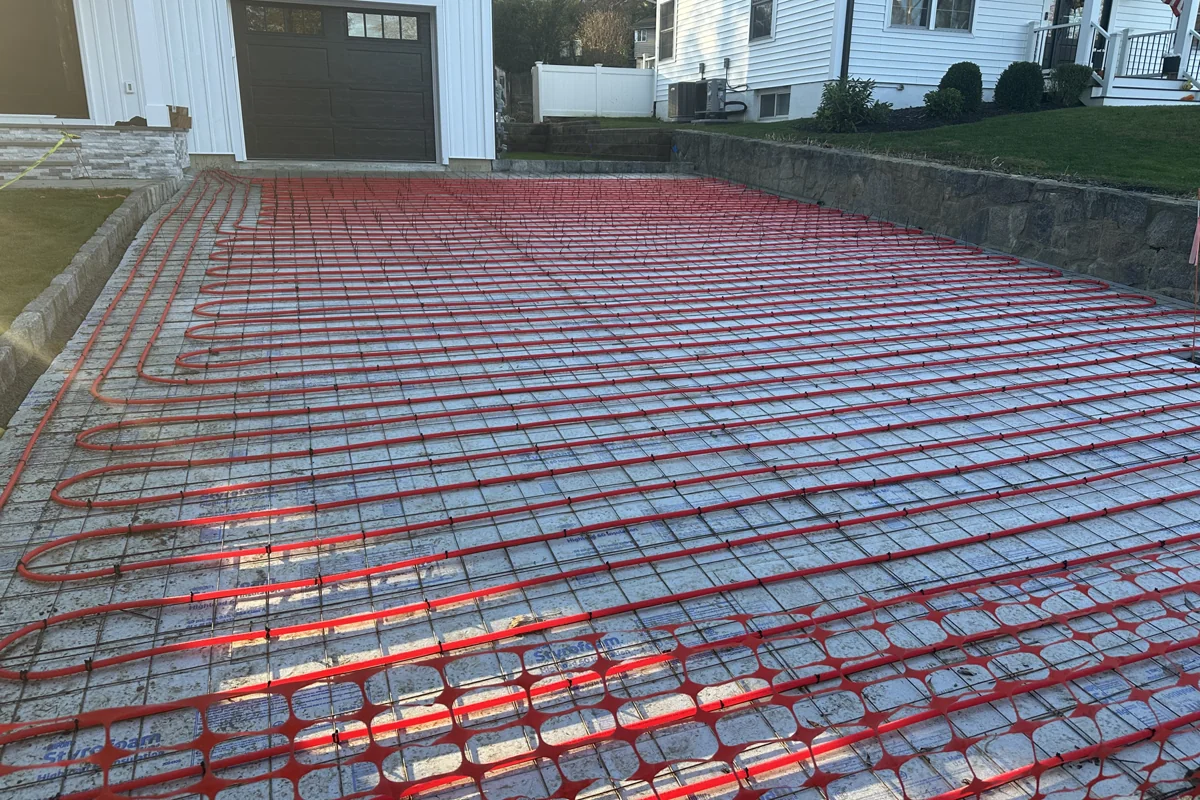
For a newly built luxury house, Yukos Mechanical installed a dedicated hydronic snow-melt system in the driveway area in front of the garage. The project offers a concrete example of how the outdoor tubing and indoor mechanical equipment work together.
- Heated driveway area: approximately 1,000 square feet.
- Calculated heating load: approximately 150 BTU/h per square foot, or 150,000 BTU/h for the heated area.
- Heat source: a dedicated Navien boiler, separate from the home’s primary heating system.
- Tubing arrangement: four loops, each approximately 400 feet long.
- Sub-base insulation: approximately four to five inches of heavy-duty rigid foam selected for the driveway application.
- Outdoor circuit: glycol mixture, dedicated circulation equipment and a plate heat exchanger.
- Control approach: outdoor temperature and moisture detection connected to the mechanical-room controller.
The installation photograph shows tubing secured to wire mesh above the insulation before driveway surfacing. It documents the construction stage; it is not a photograph of the completed surface operating during snowfall.
These figures describe this project. They are not a specification for every driveway. The calculated load is also different from a boiler’s advertised input or output rating. Read the complete snow-melt project portfolio entry for the installation overview, or explore more residential mechanical projects.
The design details that matter before the surface is installed
Weather conditions and the required result
A snow-melt design needs an agreed performance target. Wind exposure, temperature and the nature of a storm affect the heat needed. Uponor’s design and installation manual explains why performance is evaluated against design conditions rather than a universal promise to melt a fixed number of inches each hour.
Insulation, tubing and the driveway assembly
Insulation must be selected for the application, including compressive performance and moisture exposure. Tubing placement and the surface construction also need coordination. The four-to-five-inch insulation thickness in the Yukos example should not be copied into another project without reviewing that project’s assembly.
Drainage beyond the heated area
Melting snow creates water. The design must consider where that water travels, including drains and transitions to unheated surfaces where it can refreeze. The drainage plan is part of the project—not an issue to leave until after the heating equipment has been installed.
A heated driveway is not an all-weather guarantee. Ask what conditions the system is designed for and what the owner should expect when a storm exceeds those conditions. Clear expectations belong in the proposal and handover.
Does a snow-melt system need its own boiler?
Not every hydronic snow-melt project must use a separate boiler. The correct arrangement depends on the equipment, available capacity and overall design. The important point is that an existing house boiler should not be assumed to have enough spare output simply because it already heats water.
In the Yukos project, the driveway has its own Navien boiler. That choice separates the driveway’s heat source from the home’s primary heating system. A plate heat exchanger transfers heat between the boiler-water side and the outdoor glycol circuit while keeping the fluids separate.
When reviewing a proposal, ask the contractor to explain the chosen arrangement in plain language: which equipment produces the heat, which pumps move the fluid, how the outdoor circuit is protected and how the controls interact. Our boiler and hydronic heating service page explains the broader role of pumps, zones and controls in a heating system.
Automatic controls: more useful than a simple on/off switch
Automatic snow-melt controls can use temperature and moisture information to decide when heat is needed. Some products also offer preheating strategies, warm-weather shutdown or remote access. For example, the tekmar 670 control supports automatic snow/ice detection and remote operation. This is an example of available control technology, not a statement that this model was installed in the featured Yukos project.
Ask which functions are included in your proposal. How does the system start? What ends a melting cycle? Is remote monitoring included, optional or unavailable? Who can adjust settings? The answers should be documented for the homeowner rather than left as installer-only knowledge.
A useful handover also names the person to call if a sensor or controller reports a problem. An automatic system still needs an owner who understands its normal status and knows how to request service.
What affects heated-driveway installation cost?
A credible installation estimate needs more than the driveway’s total square footage. Two areas of the same size can have very different construction and mechanical requirements. Ask for a proposal that separates the heating installation from associated driveway, electrical and utility work.
- Heated area and layout: full driveway, garage apron, steps or a defined access route.
- Existing conditions: new construction, planned resurfacing, demolition or other preparation.
- Heat source and utilities: equipment, fuel availability, electrical requirements and connections.
- Distance and access: the route between the mechanical equipment and heated surface.
- Surface and drainage work: the driveway assembly and treatment of runoff.
- Controls and handover: sensors, operating functions, documentation and agreed startup work.
We have not assigned a generic installed price to this guide. The featured project’s scope does not establish a reliable price for a different property. A useful estimate identifies inclusions, exclusions and assumptions so you can compare actual scopes.
What will a heated driveway cost to run?
Running cost depends on the energy supplied, utility rates, weather, heated area and control strategy. The system’s maximum design load is not the same as its average demand throughout the winter. Ask for operating estimates that state when the system is assumed to run and whether they include preheating or idling.
For scale, consider the featured project’s 150,000 BTU/h design load. If a boiler hypothetically delivered heat at 90% efficiency, supplying that output would require about 166,700 BTU/h of fuel input, equivalent to roughly 1.67 therms per hour of natural gas. This is arithmetic using an illustrative efficiency—not the measured performance or fuel consumption of the installed Navien boiler.
Multiplying that example by an actual gas rate would estimate the fuel cost for that assumed operating hour. It would not include pump electricity or establish a monthly bill. A seasonal estimate needs assumptions about weather, run time and control settings in addition to the design-load number.
Preheating or idling can change how long the system uses energy compared with waiting for a melting request. Ask which strategy the estimate assumes and why it suits the property.
The practical question for a homeowner is: “What operating scenarios does this estimate cover?” Request separate explanations of installation cost, energy assumptions and ongoing service so a low initial quote does not hide important ownership costs.
Plan the installation before driveway construction is committed
For new construction, introduce the snow-melt scope while the builder can still coordinate the driveway design and mechanical provisions. Confirm who owns excavation and base work, who installs the tubing or heating cable, who completes the surface, and who handles electrical connections, controls and startup.
Before the heating elements are covered, agree on the required inspections, testing and photographs. Retain the layout and test records with the home’s equipment documents. For later repairs or alterations, knowing where the heating circuit runs is more useful than trying to reconstruct it from memory.
For an existing driveway, request a site-specific retrofit assessment. The surface material, condition, elevations and available installation method influence the scope. Do not assume a system can be added without disturbing the current finish, and do not commit to a paving schedule before the heating work has been coordinated.
Maintenance still matters after installation
Hydronic snow-melt equipment deserves a planned review before the season. A professional scope may include the boiler, pumps, valves, pressure, fluid condition, sensors and control response. The exact work should follow the installed equipment and fluid manufacturers’ requirements.
ASHRAE’s snow-melting guidance calls for annual glycol testing for freeze protection and inhibitor condition and advises against automotive glycol formulations for these systems. Antifreeze is a maintained part of the installation, not a permanent guarantee against freezing.
Homeowners should keep service records and report leaks, controller faults or a change in melting performance. Avoid changing fluid concentration or technical settings without the appropriate service support. For Navien equipment, our guide to boiler cleaning and descaling explains why maintenance tasks should be matched to the actual appliance and circuit. You can also discuss a property-specific scope through our HVAC maintenance plans.
What to send when requesting a heated-driveway proposal
A short, accurate project brief helps the contractor evaluate suitability and identify the right next step. You do not need to choose the boiler or design the tubing yourself.
- The property town and ZIP code.
- Approximate dimensions or a plan marking the area you want heated.
- Photos of the driveway, garage approach and proposed mechanical-equipment location.
- Whether the property is new construction, a major renovation or an existing-home retrofit.
- The intended driveway surface and current construction schedule.
- Available utilities, existing heating equipment and any known space constraints.
- Your main goal: full-driveway convenience, garage access, a walking route or another defined need.
Then ask the proposal to explain the design assumptions, equipment arrangement, construction responsibilities, startup documentation and service provisions. Confirm the contractor’s scope for local approvals and inspections rather than assuming those responsibilities sit with the paving company or general contractor.
Heated-driveway planning in Lower Westchester
Yukos Mechanical reviews residential snow-melt projects for custom homes and major renovations in Lower Westchester, including requests from homeowners, architects and builders. Selected Fairfield County, Connecticut projects are evaluated by location, scope and scheduling; coverage should be confirmed before construction commitments.
If you are planning a home in Rye, Scarsdale, Harrison, White Plains or a neighboring Lower Westchester community, start with your driveway layout and building schedule. For selected Connecticut work, review our Fairfield County service information.
Planning a heated driveway? Share the property location, approximate heated area and construction timeline. Yukos Mechanical can review the proposed scope and discuss the next step for an installation assessment.
Request a snow-melt installation assessment, call (845) 300-6653, or see the dedicated-boiler driveway project for an example of our work.