
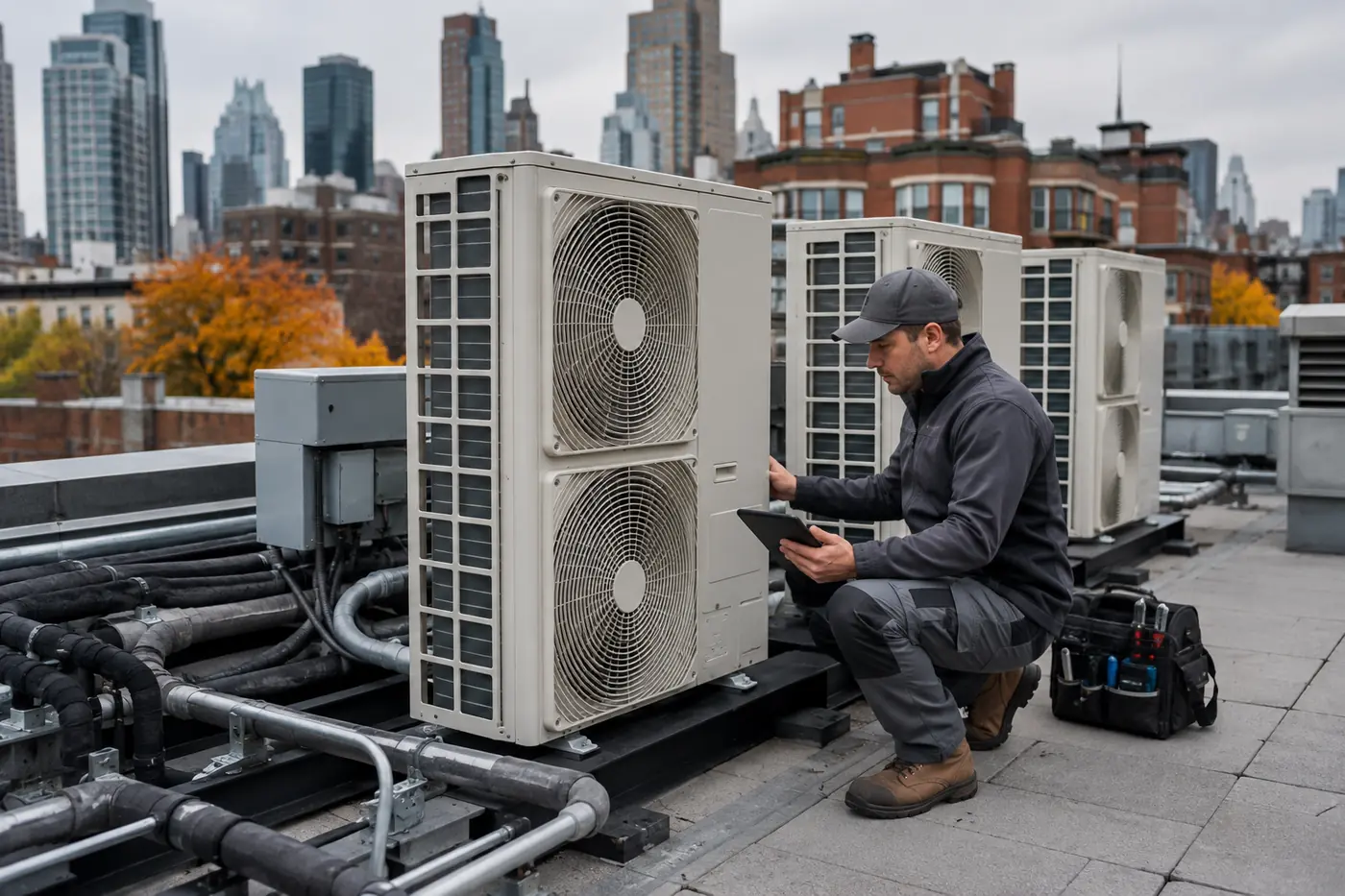
October is the month when a variable refrigerant flow system must prove that it can do more than cool. For commercial and multi-family buildings across Westchester County and New York City, a planned VRF system maintenance visit should confirm heating operation, controls, airflow, condensate management, outdoor-unit condition, and cold-weather readiness before occupants depend on the system every day.
Yukos Mechanical has installed multi-zone systems in real urban and multi-family settings, including a rooftop VRF project in the Bronx and a 12-apartment Mitsubishi project in Harrison. Those projects illustrate why October changeover is a building-level process: outdoor units, branch components, indoor units, controls, drainage, electrical service, and occupant expectations all have to work together.
Shoulder season creates a useful testing period. Outdoor temperatures are low enough to call for heat during mornings and evenings, but a failed component is less likely to become an immediate building-wide emergency than it would be in January. That gives the service team time to document faults, obtain parts, coordinate access, and retest repairs.
A changeover visit is not simply switching the controller from cooling to heating. VRF and VRV configurations vary. Some are heat-pump systems that place connected zones in one operating mode at a time; others use heat-recovery architecture that can serve simultaneous heating and cooling demands. The maintenance scope must match the installed equipment, control sequence, and manufacturer requirements.
Before opening equipment, compare this season with the last one. Property managers should provide the equipment inventory, controller map, recent fault history, open repair recommendations, and recurring comfort complaints. A useful record connects every complaint to a zone, time, setpoint, operating mode, and outdoor condition.
Look for patterns such as one apartment that never warms, an indoor unit that repeatedly shuts down, a group of zones that lose capacity together, or occupants using extreme setpoints to compensate for slow response. These patterns help distinguish a local airflow or sensor issue from a shared refrigerant, branch-controller, communication, or capacity problem.
If asset records are incomplete, use the same inventory discipline described in our guide to a commercial HVAC maintenance agreement. Model and serial numbers, served areas, controller addresses, filter sizes, access requirements, and current condition should be traceable before the winter workload begins.
Outdoor VRF equipment needs clear heat-exchange surfaces and unrestricted airflow. The technician should inspect coils, fan assemblies, guards, panels, base supports, service clearances, electrical compartments, and visible refrigerant piping. Leaves, windblown debris, damaged insulation, loose panels, and blocked discharge paths should be corrected before snow and ice complicate access.
Oil staining, deteriorated insulation, damaged flare or brazed connections, recurring pressure-related faults, and unexplained loss of performance require diagnosis. Refrigerant should never be added merely because heating feels weak. A qualified technician must determine whether the issue is airflow, controls, sensor input, charge, circuit restriction, compressor performance, or another cause. Refrigerant handling and leak work must follow applicable requirements and manufacturer procedures.
Electrical checks should be equipment-specific and performed with appropriate safety controls. The service report should document visible overheating, damaged conductors, loose connections discovered during authorized inspection, contactor condition where applicable, and operating readings that can be compared with future visits.
Every representative indoor-unit type should be tested, not just the most accessible cassette. Filters, return paths, coils, fans, louvers, and accessible condensate components affect heating delivery. A clean outdoor unit cannot compensate for a blocked filter, failed fan motor, closed grille, incorrect louver position, or furniture obstructing the discharge.
Condensate still matters in heating season. Heat-recovery operation, shoulder-season cooling, and certain indoor conditions can produce moisture even when much of the building is asking for heat. Inspect drain pans, pumps, traps, piping slope, and prior leak areas. In unconditioned locations, identify drain sections that may be exposed to freezing.
During zone testing, record entering and leaving air temperatures where appropriate, fan response, unusual noise, vibration, odor, and the time required for the space to respond. A single snapshot is less useful than a consistent set of readings tied to the controller command.
VRF complaints are often control complaints expressed as temperature problems. Confirm that central controllers, local thermostats, building-management integrations, schedules, lockouts, occupancy settings, and sensor locations agree with the intended sequence. Verify that displayed mode and commanded mode match actual equipment response.
Shared-system conflicts deserve special attention. On systems that cannot heat and cool connected zones simultaneously, one conflicting command may prevent other spaces from receiving heat. On heat-recovery systems, branch components and control logic must correctly direct refrigerant among zones. Facility staff should know which settings they may change and which should remain under central control.
Check time and date, holiday schedules, night setback, warm-up routines, remote overrides, and alarm routing. A perfect mechanical inspection can still produce Monday-morning complaints if the building automation schedule is wrong.
Air-source heat pumps move heat from outdoor air into the building during heating operation. As conditions become colder, available capacity and system behavior depend on equipment selection, design, and operating limits. The U.S. Department of Energy notes that cold climates require heat pumps designed for lower ambient temperatures. Review the installed model’s published operating range rather than applying a generic temperature claim to every system.
Confirm that defrost can initiate and terminate correctly under the required test conditions, sensors are plausible, outdoor coils are unobstructed, and meltwater has a safe path away from equipment and walkways. Steam or a temporary change in fan operation during defrost may be normal; repeated ice accumulation, persistent fault codes, or failure to recover heating capacity is not.
If the building has supplemental or backup heat, test the approved sequence and document what triggers it. Property managers should understand whether backup serves individual zones, an air handler, a separate hydronic system, or only selected critical spaces. Our guide to heat-pump cold-weather performance explains why capacity, controls, envelope load, and backup strategy must be considered together.
Routine cleaning, filter work, operating checks, records, and approved adjustments belong within maintenance. Active refrigerant leaks, failed compressors or fan motors, damaged control boards, recurring communication faults, defective sensors, failed drain pumps, broken branch components, electrical damage, and unresolved capacity loss require diagnostic and corrective work.
The service report should separate completed maintenance from observed deficiencies and recommended repairs. Each repair recommendation should identify the affected asset and zones, urgency, operational consequence, access needs, and whether the system can remain in service. This keeps repair authorization clear and prevents a general “unit needs work” note from disappearing in an email chain.
For multi-family owners planning more than maintenance, our Harrison VRF planning guide covers electrical capacity, piping, zoning, ventilation, tenant phasing, commissioning, and service access. For existing systems, October’s goal is simpler: establish a reliable heating baseline while there is still time to act.
Yukos Mechanical supports commercial and multi-family VRF systems across Westchester County and New York City, with select service in northern New Jersey and Fairfield County. Schedule an October changeover review before winter faults become occupant emergencies.
Verify outdoor units, indoor airflow, controls, drainage, defrost, and representative zone response before winter faults become occupant emergencies.
Request VRF Heating-Season ServiceSchedule the heating-mode changeover in early October, before sustained cold weather. The milder period allows time to test representative zones, diagnose faults, obtain parts, complete repairs, and retest the system.
The scope should match the installed system and may include outdoor coils and fans, piping and insulation, indoor filters and fans, drainage, sensors, controllers, schedules, heating output, fault history, defrost readiness, and representative zone response.
Not always. Some heat-pump VRF systems place connected zones in one mode at a time, while heat-recovery systems can support simultaneous heating and cooling under defined conditions. The control strategy must match the installed architecture.
A temporary vapor cloud can be normal when frost melts during defrost. Persistent ice, recurring faults, failure to recover heat, or abnormal noise requires professional diagnosis rather than assuming every visible vapor event is a malfunction.
Refrigerant leaks, failed compressors or fan motors, control-board faults, damaged sensors, failed drain pumps, electrical damage, recurring communication errors, and unresolved capacity loss require diagnostic and corrective work beyond routine maintenance.
Our clients trust us for fast, reliable HVAC solutions—see their stories below!


Whether you’re planning a new system or just need service advice, our team is here to help—no pressure, no obligations.