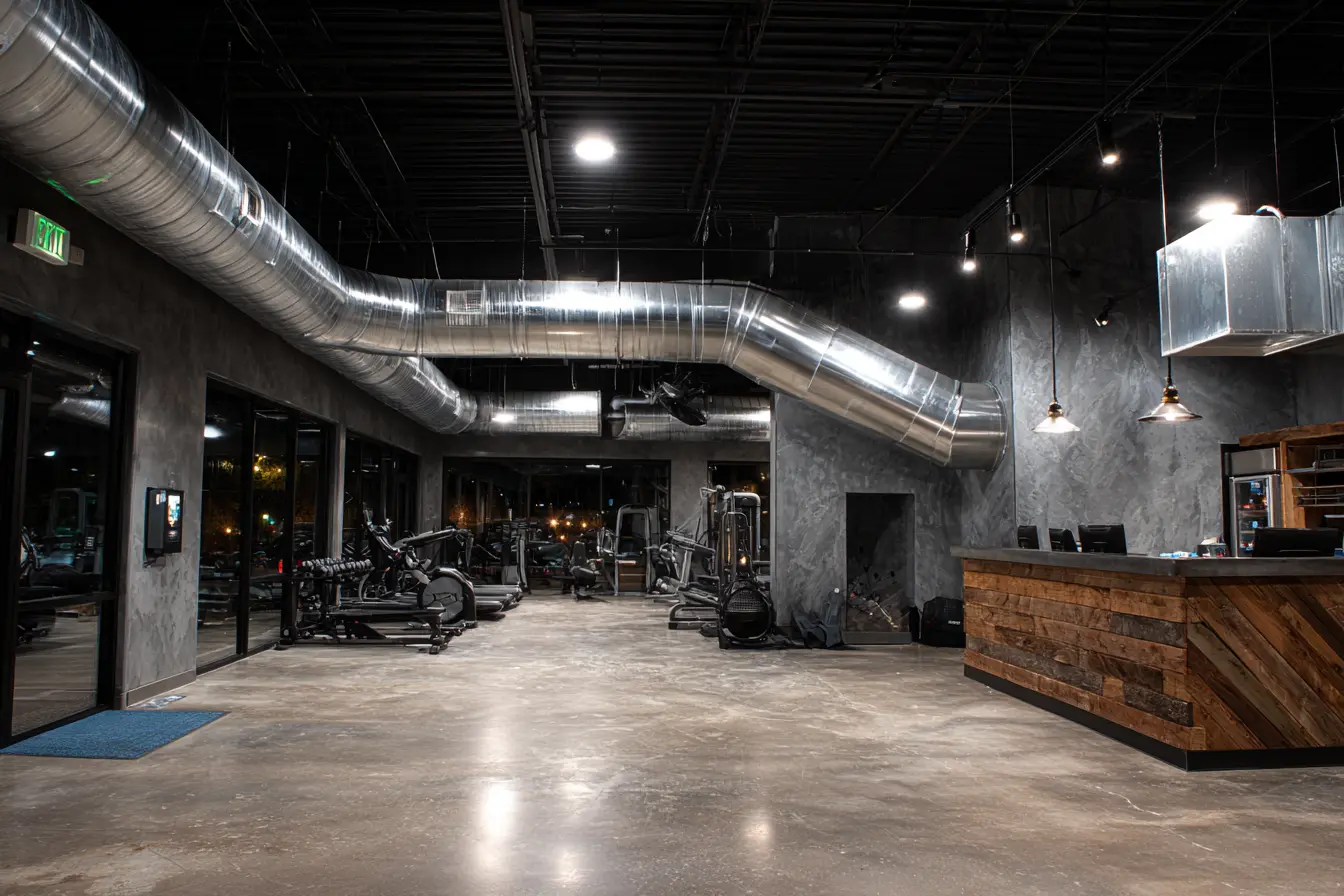
Designing HVAC systems for commercial gyms and fitness facilities requires far more than standard heating and cooling. Fitness centers generate constant heat, humidity, odor buildup, and ventilation demand throughout the day, especially during peak occupancy hours. In busy New York Tri-State facilities, HVAC systems must balance comfort, airflow, humidity control, energy efficiency, and indoor air quality simultaneously.
Modern gyms operate under some of the most demanding indoor environmental conditions found in commercial buildings. Between cardio equipment, free weights, group fitness classes, locker rooms, and high occupant density, HVAC systems must continuously manage heat loads, fresh air exchange, and moisture removal while maintaining stable comfort conditions.
Whether it is a boutique fitness studio in White Plains, a training center in Yonkers, or a retrofitted commercial gym in Westchester County, HVAC design must be customized around the building layout, occupancy patterns, ventilation needs, and operational schedule of the facility itself.
Commercial property owners evaluating large-scale ventilation and humidity-control strategies may also benefit from our guide to commercial brewery HVAC ventilation and humidity control systems, since both facility types require high-capacity airflow management and stable environmental control.
Commercial fitness facilities create environmental demands that standard office HVAC systems are not designed to handle.
Common challenges include:
Without proper HVAC planning, gyms can experience uncomfortable indoor conditions, excessive humidity, poor air quality, uneven airflow, and rising operating costs.
Commercial gym HVAC systems must prioritize ventilation and humidity control just as much as heating and cooling. Comfort alone is not enough in high-occupancy fitness environments.
Ventilation is one of the most important components in any fitness facility HVAC system.
Gyms require continuous outdoor-air exchange because occupants generate heat, moisture, and CO2 at much higher levels than standard commercial spaces.
DOAS units introduce conditioned outdoor air while exhausting stale indoor air, helping maintain consistent indoor air quality and balanced ventilation throughout the facility.
These systems are especially important in larger gyms and high-occupancy training environments.
ERV systems improve efficiency by transferring energy between outgoing and incoming air streams.
This reduces HVAC load while maintaining fresh-air ventilation requirements.
Proper ventilation design also helps reduce odors, improve occupant comfort, and support healthier indoor air quality.
Many fitness facilities discover that ventilation and fresh-air exchange become even more important than cooling alone during peak occupancy periods. For a deeper look at this topic, read our guide to why ventilation matters more than cooling in modern gyms.
Different areas inside a gym often require completely different temperature conditions.
For example:
Zoned HVAC systems allow facility managers to independently control temperatures and airflow throughout different sections of the building.
Facilities exploring advanced zoning flexibility may also benefit from our guide to water source heat pump systems for commercial buildings.
Humidity is one of the most overlooked aspects of gym HVAC system design.
Without proper moisture removal, gyms can quickly become uncomfortable and difficult to maintain.
Excess humidity may cause:
Proper dehumidification allows HVAC systems to remove moisture consistently while maintaining comfortable indoor temperatures.
Balanced airflow and humidity control are essential during humid Northeast summers.
Airflow design directly affects how efficiently a gym removes humidity.
Poor airflow circulation can create stagnant zones, uneven temperatures, and persistent moisture buildup.
Commercial facilities struggling with moisture imbalance may also benefit from our guide to humidity-control challenges in older Westchester properties.
Many commercial fitness facilities use rooftop HVAC systems because they offer strong scalability and preserve valuable interior floor space.
Advantages of rooftop units include:
In retrofit facilities or dense urban environments where rooftop access is limited, split-system configurations may be more practical.
Many Westchester gyms operate inside converted warehouses, retail spaces, or mixed-use buildings where retrofit HVAC design becomes especially important.
Many commercial gyms occupy repurposed buildings that were not originally designed for high-occupancy fitness operations.
Common retrofit challenges include:
Retrofitting these buildings often requires exposed ductwork, compact mechanical equipment, upgraded controls, and redesigned ventilation systems.
Commercial property owners evaluating system upgrades may also benefit from our guide to commercial HVAC ductwork design and airflow performance.
Fitness facilities consume large amounts of energy because HVAC systems often operate continuously for extended hours every day.
Improving efficiency helps reduce operating costs while maintaining comfort and ventilation performance.
Important efficiency strategies include:
Many of these strategies align with broader commercial HVAC energy-saving approaches used throughout Westchester commercial properties.
Indoor air quality plays a major role in gym environments because occupants breathe heavily during exercise.
Modern gym HVAC systems often incorporate:
Improved indoor air quality helps support member comfort, equipment cleanliness, and healthier training environments.
Commercial gyms throughout New York, Westchester County, and Northern New Jersey must handle dramatic seasonal weather changes.
Systems must be engineered for year-round performance without sacrificing occupant comfort or efficiency.
Because gyms operate under heavy environmental loads, preventative HVAC maintenance becomes extremely important.
Routine maintenance tasks include:
Preventative maintenance helps improve efficiency, reduce downtime, and support long-term equipment reliability.
Facility owners throughout White Plains HVAC services often rely on preventative maintenance programs to support year-round operational stability.
Commercial gyms place constant strain on HVAC systems. Regular maintenance and airflow evaluation are essential for maintaining comfort, ventilation performance, and energy efficiency.
The best HVAC strategy for a commercial gym depends on:
Modern gym HVAC systems often combine ventilation systems, humidity control, zoning strategies, and energy-efficient equipment to maintain balanced indoor conditions.
Commercial gym HVAC design requires a careful balance between ventilation, humidity control, temperature management, indoor air quality, and energy efficiency. Because fitness facilities operate under high occupancy and heavy environmental demand, HVAC systems must be engineered specifically for the building’s operational intensity.
Proper HVAC design helps improve member comfort, support healthier indoor conditions, reduce operating costs, and extend equipment lifespan throughout every season of the year.
Yukos Mechanical helps commercial property owners throughout Westchester County evaluate HVAC performance, improve ventilation systems, modernize aging equipment, and design efficient commercial comfort solutions. Contact Yukos Mechanical to schedule a commercial HVAC consultation today.
Optimize your gym’s HVAC system for performance, comfort, and long-term savings.
Get Expert ConsultationGyms generate high heat, humidity, CO2, and ventilation demand because of heavy occupancy and physical activity, requiring HVAC systems designed specifically for these environmental loads.
Excess humidity can create uncomfortable indoor conditions, condensation, mold growth, equipment corrosion, and poor indoor air quality.
Dedicated outdoor air systems, energy recovery ventilators, and balanced ventilation systems are commonly used to maintain fresh-air circulation and indoor air quality.
Yes, but retrofit HVAC design often requires upgraded ventilation, improved airflow distribution, electrical modifications, and humidity-control planning.
Commercial gym HVAC systems typically require more frequent maintenance because of heavy airflow demand, extended operating hours, and elevated indoor humidity levels.
Our clients trust us for fast, reliable HVAC solutions—see their stories below!


Whether you’re planning a new system or just need service advice, our team is here to help—no pressure, no obligations.